Quotes from Shirley Jackson’s Psychological Thrillers
By Emma Ward | On June 26, 2026 | Updated June 27, 2026 | Comments (0)

Shirley Jackson (1916 – 1965) was an American author whose work explored motifs of psychological horror. Presented here is a selection of quotes from Shirley Jackson’s best-known fiction in this genre, in which she was a master.
Many of her works addressed the dark side of human nature. “The Lottery” (1948) is her best-known short story; standouts among her novels are The Haunting of Hill House and We Have Always Lived in the Castle.
Life Among the Savages and Raising Demons pioneered the genre of “momoirs” that inspired such writers as Erma Bombeck and Jean Kerr. In Jackson’s case, her own family life wasn’t quite as fun as the glossy and wry depictions in her pages.
As a master of the psychological horror genre, Jackson influenced Stephen King and others. Having suffered from various ailments and addictions, she was only forty-eight when she died of heart failure. Even so, Jackson’s literary legacy has proven sturdy and enduring.
. . . . . . . . . .
The Lottery (1948)

“The morning of June 27th was clear and sunny, with the fresh warmth of a full-summer day; the flowers were blossoming profusely and the grass was richly green.”
. . . . . . . . . .
“Although the villagers had forgotten the ritual and lost the original black box, they still remembered to use stones.”
. . . . . . . . . .
“They stood together, away from the pile of stones in the corner, and their jokes were quiet and they smiled rather than laughed.”
. . . . . . . . . .
“Tessie Hutchinson was in the center of a cleared space by now, and she held her hands out desperately as the villagers moved in on her. “It isn’t fair,” she said. A stone hit her on the side of the head.”
. . . . . . . . .
The Road Through the Wall (1948)
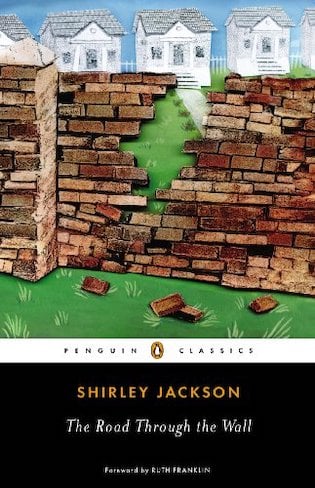
“In ten years I will be a beautiful charming lovely lady writer without any husband or children but lots of lovers and everyone will read the books I write and want to marry me but I will never marry any of them. I will have lots of money and jewels too.”
. . . . . . . . .
“The weather falls more gently on some places than on others, the world looks down more paternally on some people. Some spots are proverbially warm, and keep, through falling snow, their untarnished reputations as summer resorts; some people are automatically above suspicion.”
. . . . . . . . . .
“Outside were the eucalyptus trees, like lace against the sky. If it were only possible to lie against them, light and bodiless, sink into their softness, deeper and deeper, lost in them, buried, never come back again …”
. . . . . . . . . .
“We must expect to set a standard. Actually, however much we may want to find new friends whom we may value, people who are exciting to us because of new ideas, or because they are different, we have to do what is expected of us.”
. . . . . . . . . .
Hangsaman (1951)
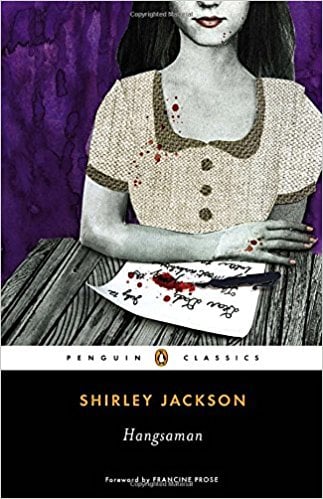
“Natalie Waite, who was seventeen years old but who felt that she had been truly conscious only since she was about fifteen, lived in an odd corner of the world of sound and sight past the daily voices of her father and mother and their incomprehensible actions.
. . . . . . . . . . .
“The gap between the poetry she wrote and the poetry she contained was, for Natalie, something unsolvable.”
. . . . . . . . . . .
“Someday I will be sixty years old, sixty-seven, eighty, and, remembering, will perhaps recall that something of this sort happened once (where? when? who?) and will perhaps smile nostalgically thinking, What a sad silly girl I was, to be sure.’”
. . . . . . . . . . . .
“Imagine, always pretending to run a world. Always imitating the sort of people they think they might be if the world were the sort of world it isn’t. Pretending to be words like ‘normal’ and ‘wholesome’ and ‘honest’ and ‘decent’ and ‘self-respecting’ and all the rest, when even the words aren’t real. Imagine, being people.”
. . . . . . . . . . . .
“‘Do you plan to be a writer?’
A what? Natalie thought; a writer, a plumber, a doctor, a merchant, a chief; the best-laid plans of; a writer the way I might plan to be a corpse? ‘A writer?’ she repeated, as though she had never heard the word before.”
. . . . . . . . . . .
The Sundial (1958)

“The sight of one’s own heart is degrading; people are not meant to look inward–that’s why they’ve been give bodies, to hide their souls.”
. . . . . . . . . . . .
“The question of belief is a curious one, partaking of the wonders of childhood and the blind hopefulness of the very old; in all the world there is not someone who does not believe something. It might be suggested, and not easily disproven that anything, no matter how exotic, can be believed by someone.
. . . . . . . . . . . .
“When shall we live if not now?”
. . . . . . . . . . . .
“Now, she thought; I may go mad, but at least I look like a lady.”
. . . . . . . . . . . .
“The experiment with humanity is at an end,” Aunt Fanny said.
“Splendid,” Mrs. Halloran said, “I“was getting very tired of all of them.”
. . . . . . . . . .
The Haunting of Hill House (1959)

“Hill House has an impressive list of tragedies connected with it, but then, most old houses have. People have to live and die somewhere, after all, and a house can hardly stand for eighty years without seeing some of its inhabitants die within its walls.”
. . . . . . . . . .
“When they were silent for a moment the quiet weight of the house pressed down from all around them.”
. . . . . . . . . .
“Materializations are often best produced in rooms where there are books. I cannot think of any time when materialization was in any way hampered by the presence of books.”
. . . . . . . . . .
“Certainly there are spots which inevitably attach to themselves an atmosphere of holiness and goodness; it might not then be too fanciful to say that some houses are born bad.”
. . . . . . . . . .
“My dear, how can I make you perceive that there is no danger where there is nothing but love and understanding?”
. . . . . . . . . .
“Nothing is ever really wasted, she believed sensibly, even one’s childhood, and then each year, one summer morning, the warm wind would come down the city street where she walked and she would be touched with the little cold thought: I have let more time go by.”
. . . . . . . . . .
We Have Always Lived in the Castle (1962)
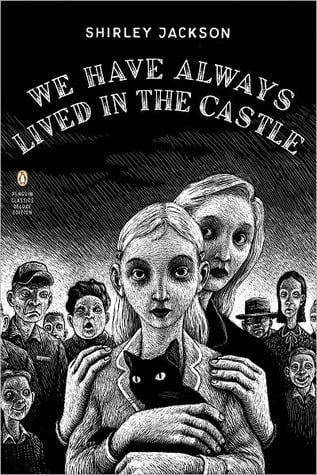
We Have Always Lived in the Castle
. . . . . . . . . .
“What are you reading, my dear? A pretty sight, a lady with a book.”
. . . . . . . . . .
“I remember that I stood on the library steps holding my books and looking for a minute at the soft hinted green in the branches against the sky and wishing, as I always did, that I could walk home across the sky instead of through the village.”
. . . . . . . . . .
“On the moon we wore feathers in our hair, and rubies on our hands. On the moon we had gold spoons.”
. . . . . . . . . .
“I was pretending that I did not speak their language; on the moon we spoke a soft, liquid tongue, and sang in the starlight, looking down on the dead dried world.”
. . . . . . . . . .
“I can’t help it when people are frightened … I always want to frighten them more.”
. . . . . . . . . .
“There had not been this many words sounded in our house for a long time, and it was going to take a while to clean them out.”
. . . . . . . . . .
“On the moon we have everything. Lettuce, and pumpkin pie and Amanita phalloides. We have cat-furred plants and horses dancing with their wings. All the locks are solid and tight, and there are no ghosts.”
. . . . . . . . . .

Shirley Jackson’s novels on Bookshop.org*
. . . . . . . . . . .
Further reading about Shirley Jackson
- Shirley Jackson on Motherhood, Experience, and Fiction Writing
- Shirley Jackson: Mother of the Fictional and Real-Life Teen
- Six Novels by Shirley Jackson: Psychological Thrillers by a Master
*This is a Bookshop.org affiliate link. If a product is purchased after linking through, Literary Ladies Guide receives a modest commission, which helps us continue to grow.
Leave a Reply