Anne Dacier, translator of Homer’s The Iliad and The Odyssey
By Marie Lebert | On September 4, 2026 | Updated September 6, 2026 | Comments (0)
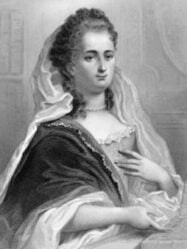
Anne Dacier (1645–1720), born Anne Le Fèvre, was a French classic scholar and one of the rare learned women in Europe who earned a living as an editor and translator.
She is best known for the prose translation of the Homeric epics from the original Greek language into French, a fifteen-year labour of love published as L’Iliade in 1711 and L’Odyssée in 1716.
The French editions were then translated into English by famed poet Alexander Pope, and published in 1715–20 for The Iliad and in 1725–26 for The Odyssey.
A good education
Raised in a Protestant family in Saumur, a town in western France, Anne Le Fèvre was taught Latin and Greek by her father Tanneguy Le Fèvre, a classic scholar who went against the tendencies of his time by giving his daughter a good education along with her brothers. She showed him her gratitude by signing her first works with the mention Anna Tanaquilli Fabri filia (Anne, Daughter of Tanneguy Le Fèvre).
Anne’s first husband was Jean Lesnier, a much older printer-bookseller who was a friend of her father’s. She separated from him in 1670 after the death of their son three weeks after his birth. Jean Lesnier died five years later, in 1675.
. . . . . . . . . .
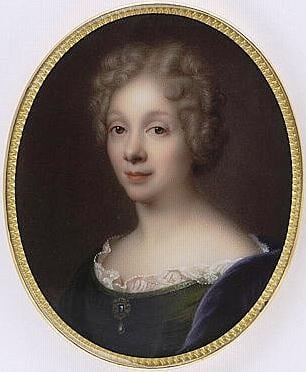
Anne Le Fèvre Dacier
. . . . . . . . . .
Working as an editor
After her father’s untimely death in 1672, Anne moved to Paris to earn a living as an editor and commentator for the Delphin Classics. The Delphin Classics (Ad usum Delphini in Latin, meaning “For the use of the Dauphin”) were a series of annotated editions of Latin and Greek classics published under the supervision of French scholar Pierre Daniel Huet, another friend of her father.
Pierre Daniel Huet was one of the tutors of the Dauphin Louis of France, the eldest son of King Louis XIV. The Delphin Classics were intended to contribute to the Dauphin’s education but they went far beyond that. The 64 volumes published between 1670 and 1698 became a literary institution.
Anne was the only woman in a team of prominent scholars. She first annotated a new Latin edition of Roman poet Publius Annius Florus (in 1674), which was widely praised while readers were very surprised to discover that its editor was a woman.
Anne edited some works by Greek poet Callimachus (in 1675, independently, from her father’s manuscript), by Greek chronicler Dictys Cretensis (in 1680), and by Roman historians Aurelius Victor (in 1681) and Eutropius (in 1683). To produce new Greek or Latin editions of these works meant writing a long preface, many notes and extensive commentary.
Working as a translator
But readers now preferred annotated French editions to annotated Latin editions. French definitively supplanted Latin in the literary world, hence the need for translations in the Delphin Classics. Anne and her colleagues switched from editing to translating.
Anne translated some works by Greek lyric poets Anacreon and Sappho (in 1681), by Greek comic playwright Aristophanes (in 1684), and by Roman comic playwrights Plautus (in 1683) and Terence (in 1688). The translations included a lengthy preface, a number of notes and a detailed commentary as well.
Anne Le Fèvre actively participated in the Quarrel of the Ancients and the Moderns (Querelle des anciens et des modernes). The literary quarrel opposed the Ancients, a group of classical writers led by poet Nicolas Boileau, and the Moderns, a group of writers who favored contemporary literature, led by author Charles Perrault (known for his fairy tales as a new literary genre). Unsurprisingly, Anne stood for the Ancients, who favored the classical authors she edited and translated.
Anne Le Fèvre married her colleague and friend André Dacier in 1683. He was a Protestant, a former student of her father, and a longtime editor of the Delphin Classics. The couple moved to Castres (André’s birthplace), a town in southern France, in 1684.
At their instigation, the whole town converted to Catholicism in 1685 to avoid persecution and destruction in a mainly Catholic country. They were rewarded by a pension granted by King Louis XIV, with 1,500 livres (the currency of the Kingdom of France) for André and 500 livres for Anne.
Back in Paris in 1686, Anne and André Dacier teamed up to translate Meditations by Roman philosopher Marcus Aurelius (1690–91) and the first six Parallel Lives by Greek philosopher Plutarch (1694). André Dacier was elected to the French Academy (Académie française) in 1695 and appointed keeper of the Library of the Louvre in 1702.
. . . . . . . . . . . .
. . . . . . . . . . . .
Translation of Homer’s epic poems
The first partial translations into French of the Homeric poems were signed by the Renaissance scholars Jacques Pelletier du Mans and Amadis Jamyn in the 16th century. Pelletier du Mans translated the first two books of The Odyssey, published in 1547 with other translations. Jamyn translated part of The Iliad, published in 1580, and began a translation of The Odyssey that was left unpublished.
One century later, a loose translation (or more exactly an adaptation) of Homer’s epic poems was penned by French scholar Achille de La Valterie from a Latin edition, and published in 1681.
After reading La Valterie’s translation, Anne Dacier was outraged by the inaccuracies and liberties taken with the Homeric texts. She undertook a translation from the original Greek language, a major task to which she devoted fifteen years of her life.
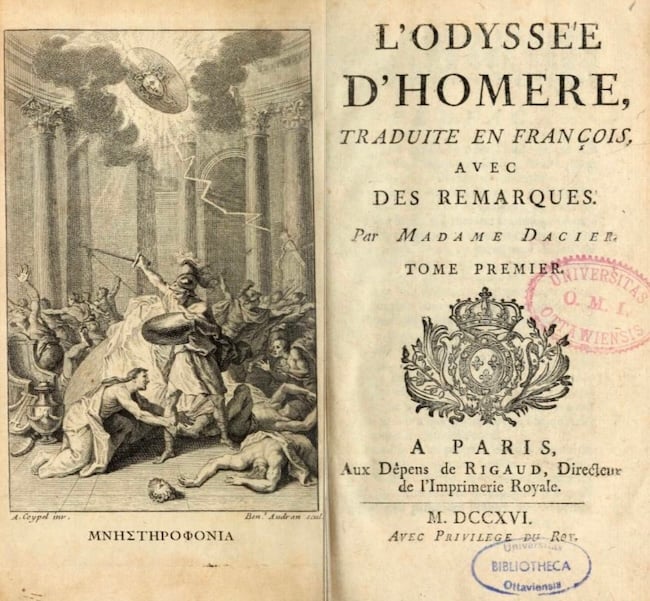
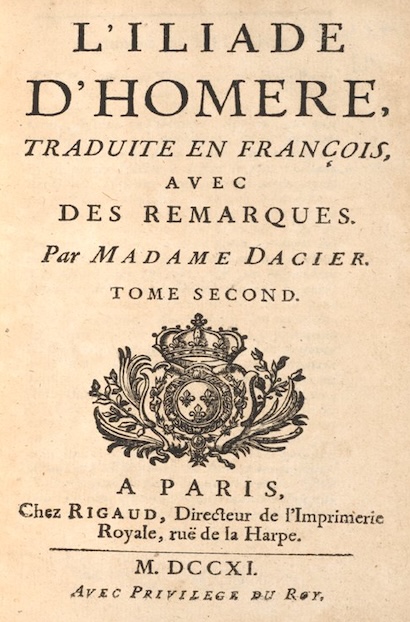
Her prose translations were published as the three-volume L’Iliade in 1711 and the three-volume L’Odyssée in 1716, with a long preface, numerous notes and extensive commentary.
Widely praised for their fidelity to the source texts, her two translations introduced Homer to her contemporaries and won over a large audience throughout Europe — French being the literary language by excellence —s while ensuring its translator’s fame.
. . . . . . . . . . . .
. . . . . . . . . . . .
Another French translation based on Dacier’s
Another French translation of The Iliad followed, this time by poet and academician Antoine Houdar de la Motte. Having little knowledge of Greek, Houdar de la Motte based his verse translation on Anne Dacier’s prose translation. The abridged verse edition was published in 1714 with just twelve instead of the twenty-four books of the full version. The text was modernized and — in the translator’s own words — improved upon the original.
An essay by Houdar de la Motte criticizing Homer’s literary merit was included in the translation under the title Discours sur Homère (Discourse on Homer), in which he explained the reasons why the epic poet failed to satisfy his own critical taste.
Deeply shocked by these criticisms, Anne Dacier rushed to Homer’s defense and penned a 445-page essay entitled Des causes de la corruption du goût (Of the Causes of the Corruption of Taste), published in 1715.
The two translators embarked on a lengthy literary debate over Homer’s talent and style, aptly named Querelle d’Homère (Quarrel of Homer) as the ultimate chapter of the Quarrel of the Ancients and the Moderns.
Other essays were penned by several prominent intellectuals, including academician Jean Terrasson, who sided with Houdar de la Motte, and philosopher Claude Buffier, who attempted to defuse the situation by demonstrating that Houdar de la Motte and Anne Dacier both celebrated Homer but in different ways.
The controversy ended in April( 1716 when the two literary rivals met at a supper they were both invited to. Houdar de la Motte finally agreed on the fact that Homer was a literary genius, and they both drank to the health of the great epic poet.
But French scholar Jean Hardouin, a former colleague of the Delphin Classics, went on with the debate in his own Apologie d’Homère (Apology of Homer), once again questioning the literary value of the Homeric texts.
Anne Dacier took up her pen again to write a 220-page essay entitled Homère défendu contre l’apologie du R. P. Hardouin (Homer Defended Against the Apology of Father Hardouin), published in 1716.
The lengthy controversy saddened the last years of her life. She died in 1720 from poor health and her husband André died two years later.
An English translation by Alexander Pope
Anne Dacier’s translation of the Homeric epics was praised by many, including English poet Alexander Pope (1688–1744), who by his own account was fascinated by Homer since his childhood. As a young man, before joining the literary society in London, he read the Homeric poems in their entirety as well as classics by Roman poets Horace, Juvenal, and Virgil.
Homer’s epic poems had already been translated into English one century earlier by poet and playwright George Chapman, a contemporary of Shakespeare who translated several Greek and Latin classics during his lifetime. Chapman published The Iliad in installments from 1598 onwards before a full translation of the two epic poems, entitled The Whole Works of Homer and published in 1616.
In 1713, Pope announced his decision to work on a new verse translation of The Iliad and signed a contract the following year with the printer-publisher Bernard Lintot, who paid him the astounding fee of 200 guineas per volume. The six-volume translation was available by subscription, with one volume published every year over six years from 1715 to 1720.
The translation of The Iliad became a bestseller and Pope went on with the translation of The Odyssey, with equivalent wages but without the need for a subscription this time, with a publication in five volumes in 1725–26.
The money earned from his two bestselling translations allowed Pope to acquire a beautiful villa in Twickenham (west of London) in 1719, where he could create his famous romantic grotto (that survives to this day) and the gardens of his dreams, two major sources of inspiration for his new poems.
Much of Pope’s translation was based on Anne Dacier’s French translation, a fact that is well known but has regularly been downplayed or bypassed for three centuries. To translate an existing translation instead of the original work was common at the time but to translate an existing translation penned by a woman was still unheard of.
In the second French edition of The Iliad, published in 1719, Anne Dacier wrote an essay on Pope’s translation of the same work, which gained her some fame in England as well.
However, after the painstaking process of translating The Iliad on his own, Pope only translated twelve books of The Odyssey himself, and secretly enlisted the help of two other poets, William Broome (who translated eight books) and Elijah Fenton (who translated four books). The secret leaked out and damaged Pope’s reputation for some time, as well as some criticisms relating to Homer’s “wild paradise” reduced to “order”, with no incidence on the sales of his two bestselling translations.
. . . . . . . . . . . .

. . . . . . . . . . . .
Much praise in the literary world and legacy
With the exception of scholar Paul Tallemant, an influential member of the Moderns who penned an epigram criticizing her husband in order to attack her, Anne Dacier was widely praised in the French literary world.
Scholar Gilles Ménage dedicated his history of women philosophers (Historia mulierum philosopharum, 1690) to her and described her in the introduction as “the most learned of women whether of the present or the past.”
Poet Nicolas Boileau praised her in the preface to his translation of On the Sublime (Traité du sublime, revised edition, 1701), a treatise penned by an unknown Greek author in the 1st century, writing about “this learned woman … who now works to make us read Aristophanes, Sophocles, and Euripides in French”.
She was also celebrated by philosophers Voltaire and Jean de La Bruyère, by fabulist Jean de La Fontaine, by memoirist Henri de Saint-Simon, by literary critic Charles Augustin Sainte-Beuve, and by many others.
Being a learned woman who was respected by her peers didn’t entirely prevent misogynistic comments from prominent male scholars. As stated by German philosopher Immanuel Kant in his Observations on the Feeling of the Beautiful and Sublime (originally published in German in 1764):
“A woman who has a head full of Greek, like Madame Dacier, or who conducts disputations about mechanics, like the Marquise du Châtelet, might as well also wear a beard; for that might perhaps better express the mien of depth [the overall appearance] for which they strive.”
But Kant certainly read their works which probably influenced his own writings.
Contemorary recognition
During the Golden Age of American comics in the mid-20th century, Anne Dacier was the heroine of a two-page biographical comic strip in the Wonder Women of History series included in Wonder Woman (number 48, 1951), the famed comic book series published by DC Comics.
She was recognized as a pioneering intellectual whose life reflected the spirit of emancipation embodied by the Wonder Woman character. She overcame the barriers imposed by her gender to become a renowned and respected editor and translator of ancient texts, including the famous Homeric poems.
Contributed by Marie Lebert. Marie is a bilingual French-English translator. She has worked as a translator and/or librarian for international organizations and has written ebooks, articles and essays about translation and translators, ebooks, libraries and librarians, and medieval art. She holds a doctorate of linguistics (digital publishing) from the Sorbonne University, Paris, and a master of social science (society and culture) from the University of Caen, Normandy. See more entries by Marie Lebert, most profiling women translators, on Literary Ladies Guide. Find more about women translators of the past at Marie Lebert.
Sources
- Thirty pioneer women writers / translators
- A history of translation in 150 portraits
- Les premières traductions françaises de L’Odyssée (in French)
Leave a Reply