Mary Louise Booth, abolitionist and translator
By Marie Lebert | On June 22, 2025 | Updated September 4, 2026 | Comments (0)
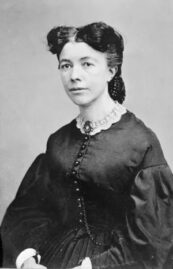
Mary Louise Booth (1831–1889), was an American writer and a prominent translator from French to English. At the beginning of the American Civil War in 1861, she translated the French anti-slavery advocate Agénor de Gasparin’s seminal book Uprising of a Great People (1861) for it to be quickly distributed in the United States.
She became the first editor of the American fashion magazine Harper’s Bazaar in 1867.
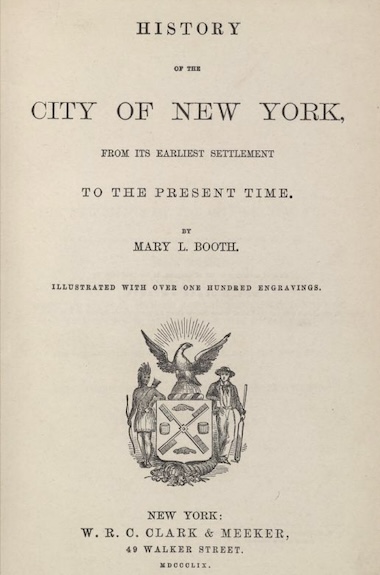
Born in Millville (now Yaphank) in the State of New York, Booth was of French descent on her mother’s side. After moving to New York City at the age of eighteen, she wrote tales and sketches for newspapers and magazines and also worked as a translator. She wrote History of the City of New York (1859), which became a bestseller.
. . . . . . . . . .
. . . . . . . . . .
Works translated by Mary Louise Booth
She is estimated to have translated up to forty books. Her first translation from French to English was The Marble-Worker’s Manual (1856), followed by The Clock and Watch Maker’s Manual.
She also translated some works by French writers Joseph Méry, Edmond François Valentin About, and Victor Cousin. She assisted the American translator Orlando Williams Wight in producing a series of translations of French classics.
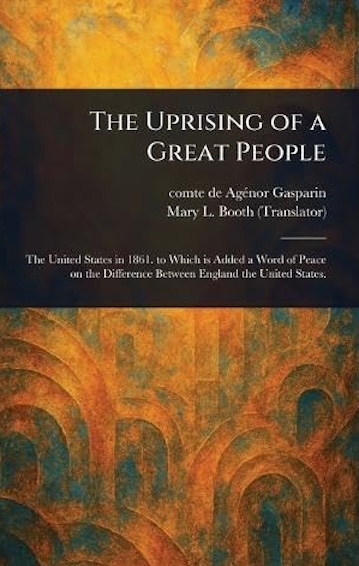
At the beginning of the American Civil War in 1861, she translated the French statesman and anti-slavery advocate Agénor de Gasparin’s seminal work Uprising of a Great People (original title: Un Grand Peuple qui Se Relève, just published in France) in a very short time by working twenty hours a day for one week. The American English edition was published in a fortnight by Scribner’s, a well-known publisher. The book caused a sensation and she received many appreciative letters for her contribution to abolitionism.
Mary Louise translated other books by anti-slavery advocates, including Agénor de Gasparin’s America before Europe (L’Amérique devant l’Europe) in 1861, politician Augustin Cochin’s Results of Emancipation and Results of Slavery (the two volumes of L’Abolition de l’Esclavage) in 1862, and jurist Édouard René de Laboulaye’s Paris in America (Paris en Amérique) in 1865.
She also translated non-political books, including Agénor de Gasparin’s religious works (written with his wife), Édouard René de Laboulaye’s Fairy Book (Contes Bleus), educator Jean Macé’s Fairy Tales (Contes du Petit-Château), historian Henri Martin’s History of France (Histoire de France”), and philosopher Blaise Pascal’s Provincial Letters (Lettres Provinciales”).
. . . . . . . . . .
. . . . . . . . . .
Mary Louise Booth as editor of Harper’s Bazaar
She was the first editor of Harper’s Bazaar, the American fashion magazine created in 1867, and kept the position for more than twenty years until her death in 1889.
Under her leadership, the magazine steadily increased its circulation and influence. After struggling financially for years as a writer and translator, she earned a larger salary than any other woman in America.
Further reading
- The Long Island History Project
- Mary Louise Booth is as Good a Friend as Ever
- Yaphank New York Historical Society, Mary L. Booth Birthplace
. . . . . . . . . . . .
Contributed by Marie Lebert. Reprinted by permission. Marie is a bilingual French-English translator. She has worked as a translator and/or librarian for international organizations and has written ebooks, articles and essays about translation and translators, ebooks, libraries and librarians, and medieval art. She holds a doctorate of linguistics (digital publishing) from the Sorbonne University, Paris, and a master of social science (society and culture) from the University of Caen, Normandy. See more entries by Marie Lebert, most profiling women translators, on Literary Ladies Guide. Find more about women translators of the past at Marie Lebert.
Leave a Reply