Claudine Picardet, French chemist, mineralogist & translator
By Marie Lebert | On June 30, 2025 | Updated September 4, 2026 | Comments (0)
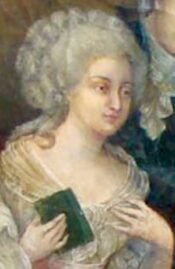
Claudine Picardet (1735–1820) was a French chemist and mineralogist whose translations of publications written by her European colleagues, contributed to the Chemical Revolution.
Picardet was the only woman scientist in the Dijon Academy (Dijon being a French town) and the only scientist who was proficient in four foreign languages (English, German, Italian, Swedish).
She translated many books and articles relating to chemistry and mineralogy for her French colleagues to keep abreast of current developments in their field.
Born in Dijon, a town in eastern France, in 1735, Claudine Picardet was the eldest daughter of the French royal notary Francois Poulet de Champlevey. She married the French barrister Claude Picardet in 1755. She attended lectures in scientific circles and joined the Dijon Academy.
Translations by Claudine Picardet
As the only woman in Academie des Sciences, Arts et Belles-Lettres de Dijon and the only scientist who was proficient in four foreign languages (English, German, Italian, Swedish), she undertook translations into French of the scientific literature of her time, mainly in chemistry and mineralogy.
These translations were essential for her colleagues to keep abreast of current developments in their field and contributed to the Chemical Revolution. The Chemical Revolution consisted in the reformulation of chemistry with new principles and theories under the leadership of French chemist Antoine Lavoisier, often called the father of modern chemistry.
Claudine translated at least three major works by the English botanist John Hill (in 1774), by the German Swedish chemist Carl Wilhelm Scheele (in 1785) and by the German geologist Abraham Gottlob Werner (in 1790).
. . . . . . . . . .
. . . . . . . . . . .
She translated hundreds of pages of scientific papers, including papers originally written in Swedish (by Carl Wilhelm Scheele and Torbern Bergman), in English (by Richard Kirwan and William Fordyce), in German (by Johann Christian Wiegleb, Johann Friedrich Westrumb, Johann Carl Friedrich Meyer and Martin Heinrich Klaproth) and in Italian (by Marsilio Landriani).
Some of her translations were published in scientific journals, for example in “Annales de chimie” [Annals of chemistry], a journal established in 1789 by three prominent French chemists: Antoine Lavoisier, Louis-Bernard Guyton de Morveau, and Claude Louis Berthollet. The rules of the editorial board stated that translators were to be paid comparably to authors.
Her other translations were circulated as manuscript copies in scientific circles. Claudine Picardet was not always credited for her work, which was common at the time for works authored or translated by women. Some early publications didn’t mention her name at all. Later publications identified her as “Mme P” or “Mme P*** de Dijon”.
Named “Bureau de traduction de Dijon” [Translation office of Dijon], the translation office was run by Louis-Bernard Guyton de Morveau, a prominent chemist and translator, and may have included half a dozen translators all together. They also carried out the laboratory experiments detailed in the articles in order to replicate experimental instructions and to confirm the results observed.
Later years and legacy
After the death of her husband in 1796, Claudine moved from Dijon to Paris. Two years later, she married Louis-Bernard Guyton de Morveau, her colleague of many years who had become a close friend.
Throughout her life, Claudine hosted renowned scientific and literary salons, first in Dijon and then in Paris. She participated actively in the collection of meteorological data, her other passion, another network created by Antoine Lavoisier in 1785 to advance knowledge in this field.
. . . . . . . . . . . .
Contributed by Marie Lebert. Reprinted by permission. Marie is a bilingual French-English translator. She has worked as a translator and/or librarian for international organizations and has written ebooks, articles and essays about translation and translators, ebooks, libraries and librarians, and medieval art. She holds a doctorate of linguistics (digital publishing) from the Sorbonne University, Paris, and a master of social science (society and culture) from the University of Caen, Normandy. See more entries by Marie Lebert, most profiling women translators, on Literary Ladies Guide. Find more about women translators of the past at Marie Lebert.
Leave a Reply