Tarbell, Herrick & McCormick: Women Who Fought to Report Front Page News
By Nava Atlas | On February 13, 2026 | Comments (0)
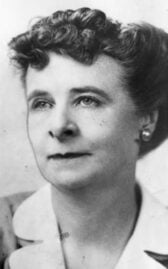
Ida Tarbell, Genevieve Forbes Herrick, and Anne O’Hare McCormick, three trailblazing journalists from the early twentieth century, fought to report hard news — the kinds of stories that have a place on the front page.
At right: Genevieve Forbes Herrick, who is very rarely depected in a photo.
The American newsroom of the first decades of the twentieth century, where front-page news was produced, was all but closed to women. Ishbell Ross, a respected journalist of the 1920s, believed that all city editors secretly thought: “Girls, we like you well enough, but we don’t altogether trust you.”
At the dawn of the 1900s, American journalism was changing at a dizzying pace. In newsrooms of major city papers, the clacking of typewriters had replaced the scribbling of pens. The linotype machine revolutionized the printing process. Now, each letter of type didn’t have to be set by hand.
Just as important, the kind of splashy undercover stories that made stunt girl reporters like Nellie Bly and Winifred Bonfils famous was falling out of favor. Investigative journalism, newly respectable, relied on careful research and fact-checking instead of wild set-ups and dramatic storytelling of earlier times.
Something else that was changing — finally — was the number of female journalists. In the 1880s there were just a few hundred in the entire country. By 1900 that number grew to nearly 2,200, and by the end of the 1930s, there were about 16,000 women in American journalism.
Sure, it was a great improvement. But the majority of “girl reporters,” as they were called, were assigned to women’s pages or features that weren’t front page news — society, home, fashion, and family.
Of course, there was nothing wrong (and there still isn’t) with covering those topics — if that’s what a woman reporter chose to do. But for the most part, female journalists weren’t given that choice and continued to be unwelcome in city newsrooms. That doesn’t mean that women had failed.
Women’s pages, as they were called, helped sell papers. By the 1930s, women were serving as editors, producing longer features and Sunday magazines, and working in business, art, mechanical, and promotional departments. Here, we’ll look at the careers of three women journalists whose hard news reporting made it to the front page despite the odds.
. . . . . . . . . .
Ida Tarbell
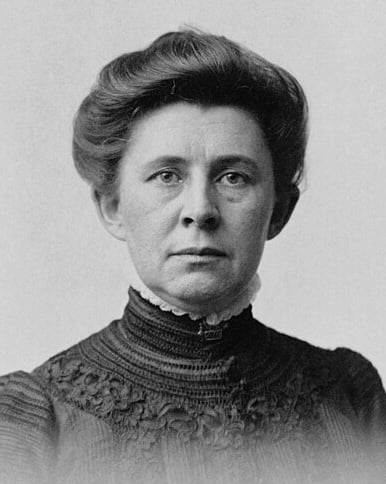
Ida M. Tarbell in 1904
Ida M. Tarbell (1857 – 1944) was known as “muckraker” — a word coined by president Theodore Roosevelt describing journalists who exposed big business’s shady dealings. He didn’t mean it as a compliment. Ida Tarbell’s reputation as a muckraker made her a pioneer in the new brand of detailed investigative journalism. She’s still considered one of the best ever.
Her most famous investigation was of Standard Oil’s unfair business practices, called The History of Standard Oil. This title might sound like a snoozefest, but Tarbell wrote the nineteen-part series in a way that captured readers’ imaginations and made them eager for the next installments.
Through her careful research, Tarbell proved that corporate monopolies hurt the public. Her series led to the 1911 Supreme Court decision that ruled against Standard Oil and broke it apart. Though this was the highlight of her career, Ida never stopped writing.
Tarbell was mainly interested in politics and presidents and was a Lincoln scholar. Strangely, she was against women’s right to vote, making her unpopular with other female journalists and reformers of her time. Still, whenever you see a list of most influential journalists of all time — male or female — Ida Tarbell’s name is always near the top.
. . . . . . . . . .
Genevieve Forbes Herrick
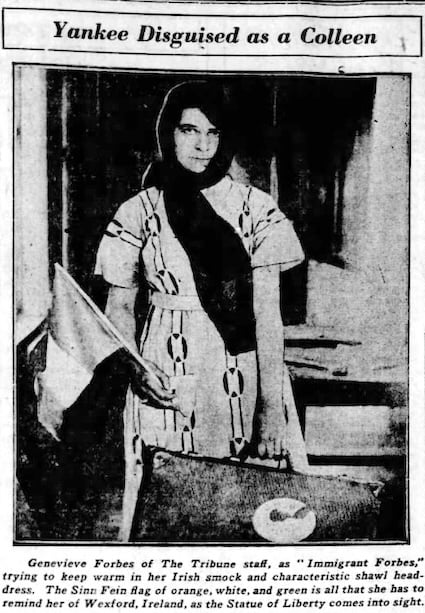
Herrick went undercover to investigate immigration in 1921
Genevieve Forbes Herrick (1894 – 1962) bridged the gap between stunt reporting and the newer breed of investigative journalist. Brilliant and ambitious, she joined the Chicago Tribune in 1921 with a master’s degree to her credit.
The Tribune wanted to steer her toward the women’s pages, but she refused. Instead, Herrick talked her editors into letting her pose as a poor Irish girl to experience what it was like to immigrate to America. Her reporting recounted the terror of the ocean voyage from Ireland and the terrible treatment immigrants faced after arriving through Ellis Island.
Herrick told the hidden truth of how women were forced to strip for unneeded medical exams; how passengers were kicked and shoved into lines by authorities; and how newly arrived parents and children were forcibly separated. Genevieve was asked to testify before the House of Representatives, which resulted in improved conditions at Ellis Island.
Because this exposé was so successful, the Tribune let Herrick report on whatever topics she chose. Through the 1920s and 1930s, she covered politics and promoted women running for office. One of them was Ruth Hanna McCormick, who ran for the House of Representatives in 1928 — and won.
Herrick’s reporting was fearless, whether she was going after Chicago’s corrupt politicians or the city’s mob bosses.
. . . . . . . . . .
Anne O’Hare McCormick
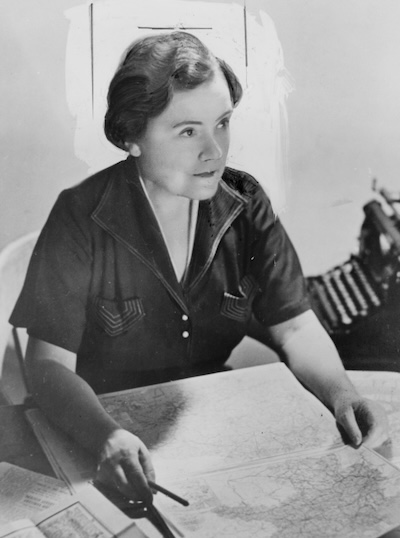
Anne O’Hare McCormick, 1941
(photo from the collection of the Library of Congress)
Anne O’Hare McCormick (1880–1954) started out freelancing for newspapers and magazines. Her career chugged along steadily, though writing about this and that wasn’t very exciting.
That changed in 1921 when her husband was sent to Europe for his work. She asked the New York Times’ managing editor if she could send him reports from overseas. For a woman to be a foreign correspondent was practically unheard of, but the editor agreed.
McCormick plunged right into some of the most challenging topics, including the first in-depth look at the Italian dictator Benito Mussolini’s rise to power. She documented and reported on the gathering storm of fascism in Europe.
In 1936, McCormick became the first woman to be appointed to the New York Times’ editorial board. The paper’s publisher instructed her: “You are to be the ‘freedom’ editor. It will be your job to stand up … and shout whenever freedom is interfered with in any part of the world.” The following year Anne won the Pulitzer Prize for foreign correspondence — another female first.
She continued to be an active journalist through the World War II years, and was called “the expert the experts looked up to.” Anne O’Hare McCormick often sounded the first alarm about dangerous dictators. She was trusted by American presidents and respected by everyday readers who learned about the world from her popular column, “Abroad.”
. . . . . . . . . . . .
More about trailblazing journalists on Literary Ladies Guide
- Radio Days: Trailblazing Women Journalists on the Airwaves
- Colonial America’s Intrepid Women Newspaper Publishers
- See the entire category featuring historic women journalists
Leave a Reply