Thoughtful Quotes from the Works of Kate Chopin
By Skyler Gomez | On May 29, 2017 | Updated December 24, 2025 | Comments (0)
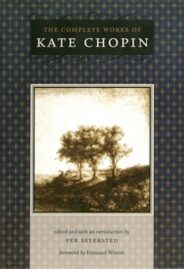
Kate Chopin (1850 – 1904) started her writing career with stories for magazines such as Vogue and The Youth Companion. She is known to be a foremother of twentieth century feminism and often wrote in a realist perspective, reflecting the setting of her time.
Here we’ll sample some thoughtful quotes by Kate Chopin, best known for the 1899 short novel The Awakening.
Chopin went through much loss and hardship in her life and suffered from depression, which also influenced the themes in her work. She was quite prolific for some dozen years, producing numerous short stories and two other novels, as well as plays and poems.
. . . . . . . . . .
Quotes from “The Awakening” (1899)
The Awakening is Kate Chopin’s 1899 novella depicting one woman’s struggle with societal expectations in her role as a wife and mother. The story of a young Creole woman who craves more than the society-sanctioned role of wife and mother — let alone her indulgence in marital infidelity — shocked reviewers and readers alike. Read the full text of The Awakening here.
. . . . . . . . . .
“Some people are born with a vital and responsive energy. It not only enables them to keep abreast of the times; it qualifies them to furnish in their own personality a good bit of the motive power to the mad pace.”
. . . . . . . . . .
“Her marriage to Leonce Pontellier was purely an accident, in this respect resembling many other marriages which masquerade as the decrees of Fate.”
. . . . . . . . . .
“She wanted something to happen — something, anything: she did not know what.”
. . . . . . . . . .
“She missed him the days when some pretext served to take him away from her, just as one misses the sun on a cloudy day without having thought much about the sun when it was shining.”
. . . . . . . . . .
“There are periods of despondency and suffering which take possession of me. But I don’t want anything but my own way. That is wanting a good deal, of course, when you have to trample upon the lives, the hearts, the prejudices of others.”
. . . . . . . . . .
“There are some people who leave impressions not so lasting as the imprint of an oar upon the water.”
. . . . . . . . . .
“To be an artist includes much; one must possess many gifts — absolute gifts — which have not been acquired by one’s own effort. And, moreover, to succeed, the artist much possess the courageous soul … the brave soul. The soul that dares and defies.”
. . . . . . . . . .
“The generous abundance of her passion, without guile or trickery, was like a white flame which penetrated and found response in depths of his own sensuous nature that had never yet been reached.”
. . . . . . . . . .
“In the procession I should feel the crushing feet, the clashing discords, the ruthless hands and stifling breath. I could not hear the rhythm of the march.”
. . . . . . . . . .
“I would give up the unessential; I would give my money, I would give my life for my children; but I wouldn’t give myself. I can’t make it more clear; it’s only something I can beginning to comprehend, which is revealing itself to me.”
. . . . . . . . . .
“A certain light was beginning to dawn dimly within her — the light which, showing the way, forbids it.”
. . . . . . . . . .
“It was not despair, but it seemed to her as if life were passing by, leaving its promises broken and unfulfilled. Yet there were other days when she listened, was led on and deceived by fresh promises which her youth had held out to her.”
. . . . . . . . . .
Quotes from A Pair of Silk Stockings (1897)
“A Pair of Silk Stockings” follows Mrs. Sommers, a young mother, who spends an unexpected windfall of fifteen dollars on herself, rather than on her children as she had originally planned. This story has been reprinted in several collections of Kate Chopin’s short works, and you’ll find the full text of it here.
“Little Mrs. Sommers one day found herself the unexpected possessor of fifteen dollars. It seemed to her a very large amount of money, and the way in which it stuffed and bulged her worn old porte-monnaie gave her a feeling of importance such as she had not enjoyed for years.”
. . . . . . . . . .
“Mrs. Sommers was one who knew the value of bargains; who could stand for hours making her way inch by inch toward the desired object that was selling below cost.”
. . . . . . . . . .
She seated herself at a small table alone, and an attentive waiter at once approached to take her order. She did not want a profusion; she craved a nice and tasty bite.”
. . . . . . . . . .
“While waiting to be served she removed her gloves very leisurely and laid them beside her. Then she picked up a magazine and glanced through it, cutting the pages with a blunt edge of her knife. It was all very agreeable.”
. . . . . . . . . .
There were many others who were there solely for the play and acting. It is safe to say there was no one present who bore quite the attitude which Mrs. Sommers did to her surroundings. She gathered in the whole — stage and players and people in one wide impression, and absorbed it and enjoyed it.”
. . . . . . . . . .
Quotes from “The Story of an Hour” (1894)
This short story’s main character, Louise Mallard, who has a weak heart, learns that her husband has died in an accident. The hour referred to in the title is the time that elapses after she receives this news. At first, Louise collapses into her sister’s arms, but then, when she is alone with her thoughts, she whispers, “Free! Body and soul free!” Rather than feeling devastated, she feels quite liberated.
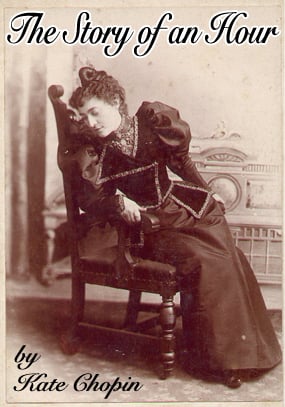
“There stood, facing the open window, a comfortable, roomy armchair. Into this she sank, pressed down by a physical exhaustion that haunted her body and seemed to reach into her soul.
. . . . . . . . . .
“There was something coming to her and she was waiting for it, fearfully. What was it? She did not know; it was too subtle and elusive to name. But she felt it, creeping out of the sky, reaching toward her through the sounds, the scents, the color that filled the air.
. . . . . . . . . .
“There would be no one to live for her during those coming years; she would live for herself. There would be no powerful will bending hers in that blind persistence with which men and women believe they have a right to impose a private will upon a fellow-creature.”
. . . . . . . . . .
“She said it over and over under the breath: ‘free, free, free!’ The vacant stare and the look of terror that had followed it went from her eyes.
. . . . . . . . . .
“And yet she had loved him — sometimes. Often she had not. What did it matter!
. . . . . . . . . .
Quotes from “Désirée’s Baby” (1893)
In this short story, Chopin wove in the themes that would come to define her works, including women’s struggle for equality, the vagaries of identity, and racial conflict. Abandoned as a baby, Désirée is the adopted daughter of Monsieur and Madame Valmondé, wealthy French Creoles. When she reaches young womanhood she marries Armand, the son of another wealthy French Creole family, and suffice it to say that complications ensue. Read Désirée’s Baby in full here.

The passion that awoke in him that day, when he saw her at the gate, swept along like an avalanche, or like a prairie fire, or like anything that drives headlong over all obstacles.
The young mother was recovering slowly, and lay full length, in her soft white muslins and laces, upon a couch. The baby was beside her, upon her arm, where he had fallen asleep, at her breast.
“Oh, Armand is the proudest father in the parish, I believe, chiefly because it is a boy, to bear his name; though he says not — that he would have loved a girl as well. But I know it isn’t true. I know he says that to please me. And mamma.”
When the baby was about three months old, Désirée awoke one day to the conviction that there was something in the air menacing her peace. It was at first too subtle to grasp.”
He coldly but gently loosened her fingers from about his arm and thrust the hand away from him. “Tell me what it means!” she cried despairingly. “It means,” he answered lightly, “that the child is not white; it means that you are not white.”
“She disappeared among the reeds and willows that grew thick along the banks of the deep, sluggish bayou; and she did not come back again.”
. . . . . . . . . .
Quotes from “The Storm” (1898)

Even before the brutal reception of The Awakening, Kate Chopin may have sensed that it would be risky to send “The Storm” out for consideration. It was never published in her lifetime, and indeed, not for many decades afterward — not until 1969, when it was included in The Complete Works of Kate Chopin.
Chopin biographer Per Seyersted wrote: “Sex in this story is a force as strong, inevitable, and natural as the Louisiana storm which ignites it.” The story “… covers only one day and one storm and does not exclude the possibility of later misery. The emphasis is on the momentary joy of the amoral cosmic force.” Read “The Storm” in full here.
. . . . . . . . . .
“Bobinot, who was accustomed to converse on terms of perfect equality with his little son, called the child’s attention to certain sombre clouds that were rolling with sinister intention from the west, accompanied by a sullen, threatening roar.”
. . . . . . . . . .
“She was a little fuller of figure than five years before when she married; but she had lost nothing of her vivacity. Her blue eyes still retained their melting quality; and her yellow hair, dishevelled by the wind and rain, kinked more stubbornly than ever about her ears and temples.”
. . . . . . . . . .
“The contact of her warm, palpitating body when he had unthinkingly drawn her into his arms, had aroused all the old-time infatuation and desire for her flesh.”
. . . . . . . . . .
“As she glanced up at him the fear in her liquid blue eyes had given place to a drowsy gleam that unconsciously betrayed a sensuous desire. He looked down into her eyes and there was nothing for him to do but to gather her lips in a kiss.”
. . . . . . . . . .
“The generous abundance of her passion, without guile or trickery, was like a white flame which penetrated and found response in depths of his own sensuous nature that had never yet been reached.”
“When he touched her breasts they gave themselves up in quivering ecstasy, inviting his lips. Her mouth was a fountain of delight. And when he possessed her, they seemed to swoon together at the very borderland of life’s mystery.”
. . . . . . . . . .
More about Kate Chopin
- Review by Willa Cather of The Awakening
- The Awakening: An Analysis
- On Certain Brisk, Bright Days (Kate Chopin on Writing)
- Quotes from The Awakening by Kate Chopin
- Analysis of “Desirée’s Baby” (1893 short story)
Leave a Reply