“I Do Not Consent” The Life of Writer and Activist June Jordan
By Elodie Barnes | On May 8, 2026 | Updated June 15, 2026 | Comments (0)
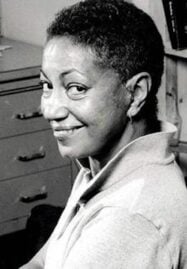
June Jordan (July 9, 1936 – June 14, 2002) was a poet, playwright, and essayist, known for her political activism and commitment to human rights.
Her writing spanned thirty years and nearly thirty books, covering subjects such as marginalization, oppression, and inequality, as well as racial, political, and sexual identity.
She was also passionate about the use of Black English in writing and in education, and had a thriving teaching career in several universities.
Early life in New York
June Millicent Jordan was born in the Harlem section of New York City in 1936 and raised in Bedford-Stuyvesant, Brooklyn. Her parents, Mildred and Granville Jordan were immigrants from Panama and Jamaica, respectively. An only child, she had a difficult relationship with her father, who never hid his disappointment that she was not a boy.
Later, she would write, “For a long while during childhood I was relatively small, short, and, in some other ways, a target for bully abuse. In fact, my father was the first regular bully in my life.” However, she credited him with passing along his love of literature, and by age seven, she began writing her own poetry. Her mother later took her own life. Fifteen years later, in a 1981 essay called “Many Rivers To Cross,” Jordan wrote:
“I thought about the idea of my mother as a good woman and I rejected that, because I don’t see why it’s a good thing when you give up, or when you cooperate with those who hate you…I came too late to help my mother to her feet. By way of everlasting thanks to all the women who have helped me to stay alive I am working never to be late again.”
She attended Midwood High School in Brooklyn for a year, followed by the elite Northfield School in Massachusetts. The student bodies of both schools were predominantly white. In 1953, she attended Barnard College in New York (the women’s college affiliated with Columbia University), but also felt alienated as a Black student, and by the white-centered curriculum. In her 1981 book of essays, Civil Wars, she wrote of the experience:
“No one ever presented me with a single Black author, poet, historian, personage, or idea for that matter. Nor was I ever assigned a single woman to study as a thinker, or writer, or poet, or life force.” Because of this disconnect, Jordan left Barnard without graduating.
. . . . . . . . . .
. . . . . . . . . .
Marriage, divorce, and sexual identity
In 1955, Jordan met and married Michael Meyer, a white student at Columbia University. She followed him to the University of Chicago, where she also enrolled, but ultimately returned to Barnard and graduated with a Bachelor of Arts degree in 1957.
In 1958, she gave birth to the couple’s only child, Christopher, and raised him alone after she and Meyer divorced in 1965.
Jordan always identified openly as bisexual, saying, “Bisexuality means I am free and I am as likely to want to love a woman as I am likely to love a man, and what about that? Isn’t that what freedom implies?” After her death in 2019, she was one of the first fifty American “pioneers, trailblazers and heroes” inducted into the National LGBTQ Wall of Honor at the Stonewall National Monument in New York City.
A life dedicated to activism
Jordan was active in the civil rights, feminist, anti-war, and gay rights movements. She attended rallies, marches, events and conferences throughout her life. She wrote in Civil Wars: Selected Essays (Boston: Beacon Press, 1981).
“It seems unreasonable that more than 400 million people, right now, struggle against hunger and starvation, even while there is an arable earth aplenty to feed and nourish every one of us. It does not seem reasonable that the color of your skin should curse and condemn all your days and the days of your children. It seems preposterous that gender, that being a woman, anywhere in the world, should elicit contempt, or fear, or ridicule, and serious deprivation of rights to be, to become, to embrace whatever you choose…”
After the Harlem Riots of 1964 (in which James Powell, a Black teen, was shot dead by an NYPD officer – a shooting which sparked six nights of rioting and clashes between protestors and the police), Jordan was “filled with hatred for everything and everyone White.”
It was a conversation with civil rights leader Fannie Lou Hamer that led her to eventually believe that “this condition, if it lasted, would mean that I had lost the point: not to resemble my enemies, not to dwarf my world, not to lose my willingness and ability to love.”
After the riots, she collaborated with architect Buckminster Fuller on an architectural redesign of Harlem to improve living conditions for residents. However, the plan was never developed.
Jordan was also a passionate supporter of Palestinian rights, and said that the Palestinian struggle was the “moral litmus test” of her life. After traveling to Lebanon in 1982 and visiting the Sabra and Shatila refugee camps, and seeing the devastation of the Israeli massacres there firsthand (and then returning in 1996), she wrote in the poem “Apologies to All the People in Lebanon”:
“Yes I did know it was the money I earned as a poet that / paid / for the bombs and the planes and the tanks / that they used to massacre your family… I’m sorry. I really am sorry.”
. . . . . . . . . .
. . . . . . . . . .
Teaching career
Jordan’s teaching career began in 1967 when, after running poetry workshops for children in Harlem, she began teaching at the City College of New York. Later, she taught at Yale University and Sarah Lawrence College, and became Professor of English at Stony Brook, where she directed the Poetry Center.
In 1988, she became Professor of African American Studies at the University of California at Berkeley, where, in 1991, she co-founded Poetry for the People with Janice Mirikitani – a program to train undergraduates to bring poetry into community groups as a form of political and social empowerment.
She was known for using Black English both in her own writing and in her teaching. She saw it as a vital way of keeping the community and culture alive, and she encouraged her students to respect it as its own language and to use it in their own work.
Her essay, “Nobody Means More to Me Than You and the Future Life of Willie Jordan,” criticizes the use of “White English” as standard English, saying that “compulsory education in American compels accommodation to exclusively White forms of ‘English.’”
“To rally the spirit of your folks”:
an extensive writing career
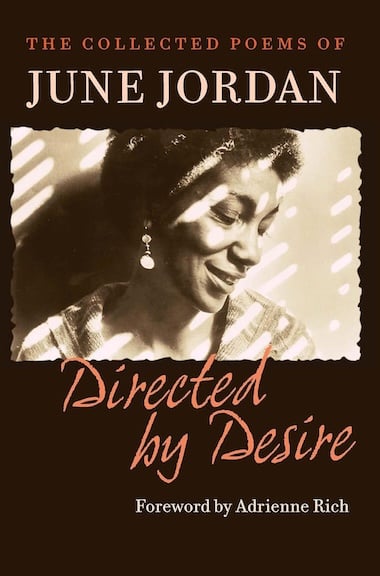
In 1969, Jordan published her first volume of poetry, Who Look at Me. This was followed by several books for children and young adults, including His Own Where (1971), Dry Victories (1972), New Life, New Room (1975), and Kimako’s Story (1981).
Later, she explored her own childhood in the memoir Soldier: A Poet’s Childhood (2000), and in a NewsHour interview with Elizabeth Farnsworth, she said of the book,
“I wanted to honor my father, first of all, and secondly, I wanted people to pay attention to a little girl who is gifted intellectually and creative, and to see that there’s a complexity here that we may otherwise not be prepared to acknowledge or even search for…” In a separate interview, she said, “My father was very intense, passionate, and over-the-top. He was my hero and my tyrant.”
She also wrote poetry and fiction, and librettos for the operas Bang Bang Uber Alles, and I was Looking at the Ceiling and Then I Saw the Sky. Her journalism was published widely, and she was a regular columnist for The Progressive. Her essays were largely political, and in collections such as Civil Wars (1981), On Call (1985), and Technical Difficulties (1992), her topics ranged from conflicts in South Africa, Nicaragua, and Lebanon, to issues of race and class in the U.S.
Jordan often wrote about her personal experiences in her work, including the experience of being raped. In ‘Poem About My Rights’, she wrote, “I have been raped / be- / cause I have been wrong the wrong sex the wrong age / the wrong skin the wrong nose the wrong hair the / wrong need the wrong dream the wrong geographic / […] / but let this be unmistakeable this poem / is not consent I do not consent / […] / I am not wrong: wrong is not my name”
When she was asked about the role of a poet in society, she replied, “The role of a poet, beginning with my own childhood experience, is to deserve the trust of people who know that what you do is work with words … Then the task of a poet of color, a Black poet, as a people hated and despised, is to rally the spirit of your folks …”
She was awarded a number of prestigious grants, including Fellowships from the National Endowment for the Arts, Massachusetts Council on the Arts, and the New York Foundation for the Arts, as well as the National Association of Black Journalists Award and a Rockefeller Foundation Grant. She was also a finalist for the National Book Award in 1972 for His Own Where.
. . . . . . . . . .
. . . . . . . . . .
Later years
Jordan was diagnosed with breast cancer in the 1990s, but continued to teach, write, and protest. She died in June 2002 at her home in Berkeley, California.
In an obituary, Lynell George wrote in the Los Angeles Times, “[Jordan] spent her life stitching together the personal and political so the seams didn’t show,” while Jordan’s contemporary, Toni Morrison, said of her career, “I am talking about a span of forty years of tireless activism coupled with and fueled by flawless art.”
. . . . . . . . . .
Contributed by Elodie Barnes. Elodie is a writer and editor with a serious case of wanderlust. Her short fiction has been widely published online and is included in the Best Small Fictions 2022 Anthology published by Sonder Press. She is Books & Creative Writing Editor at Lucy Writers Platform, she is also co-facilitating What the Water Gave Us, an Arts Council England-funded anthology of emerging women writers from migrant backgrounds. She is currently working on a collection of short stories, and when not writing can usually be found planning the next trip abroad, or daydreaming her way back to 1920s Paris. Find more of her writings here and on Literary Ladies Guide.
More about June Jordan
Further reading
-
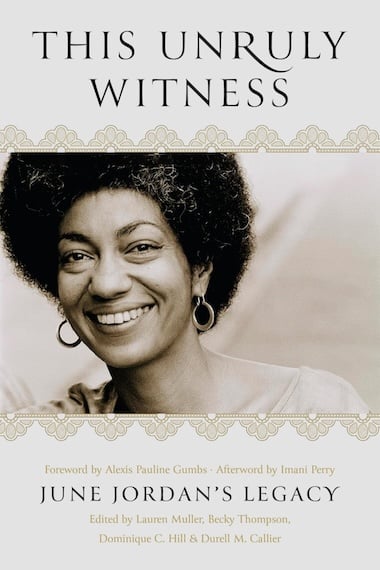
- This Unruly Witness: June Jordan’s Legacy, ed. by Lauren Muller, Becky Thompson,
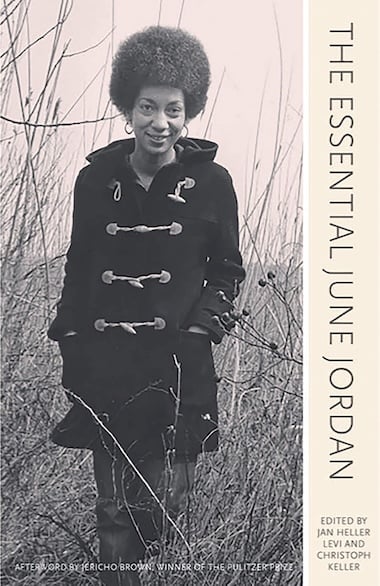
Dominique C. Hill. Haymarket Books, 2025 - The Essential June Jordan, ed. Jan Heller Levi and Christoph Keller, Penguin Classics, 2021
- Passion (Poems), by June Jordan, Penguin Classics, 2025
- Haruko/Love Poems, by June Jordan, Serpent’s Tail Classics, 2023
- June Jordan on America’s Black Holocaust Museum
- Poetry Foundation
- This Unruly Witness: June Jordan’s Legacy, ed. by Lauren Muller, Becky Thompson,
Leave a Reply