Tove Ditlevsen, Danish author of The Copenhagen Trilogy
By Elodie Barnes | On August 23, 2026 | Comments (0)
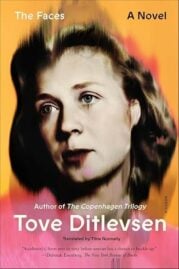
Tove Ditlevsen (December 14, 1917 – March 7, 1976) was a Danish author best known for The Copenhagen Trilogy, an account of her life from childhood to adulthood, marriage, and drug addiction. She was also an accomplished and prolific poet.
Her contemporaries largely marginalized her work, despite the name she made for herself in Danish literary circles.
Ditlevsen’s work has seen a resurgence with the reissue of much of her body of work, especially the autofictional Copenhagen Trilogy, which has been translated into some thirty languages.
Tove Ditlevsen’s working-class roots
Tove Irma Margit Ditlevsen was born in Copenhagen in 1917. She grew up in Vesterbro, which was then a working-class district, with her parents and older brother, Edvin. Her father was a coal stoker.
In the Copenhagen Trilogy, Ditlevsen wrote, “Down at the bottom of my childhood my father stands laughing. He’s big and black and old like the stove, but there is nothing about him that I’m afraid of.”
Her mother, on the other hand, was, “Beautiful, untouchable, lonely, and full of secret thoughts I would never know …” Her capricious temper ruled the household, and the young Tove would often find herself on the end of her mother’s “dark anger [that] always ended in her slapping my face or pushing me against the stove.”
It was an unhappy childhood. Ditlevsen recalled: “Time passed and my childhood grew thin and flat, paper-like. It was tired and threadbare, and in low moments it didn’t look like it would last until I was grown up.”
Early forays into poetry
Despite her father’s warning that “a girl can’t be a poet,” Ditlevsen began writing poems at the age of ten. She later described these as “long, mysterious words [that] began to crawl across my soul like a protective membrane. A song, a poem, something soothing and rhythmic and immensely pensive, but never distressing or sad, as I knew the rest of my day would be distressing and sad.”
Ditlevsen began submitting these poems to literary magazines while in her teens. Meanwhile, she left school at sixteen to help her family financially, working at a series of low-paying jobs, including typist, stock clerk, and receptionist. Still, she continued to write.
Her first published poem appeared in the Danish journal Vild Hvede (Wild Wheat) in 1937. Her first poetry collection, Pigesind (From A Girl’s Mind) was published in 1939.
Following these early poetry collections, she produced a book every year or two until her death. It was a remarkably prolific output that included eleven books of poetry, seven novels, four collections of short stories, and the Copenhagen Trilogy – as well as countless articles and a long-running “agony aunt” column in the women’s weekly Familie Journalen.
. . . . . . . . . .
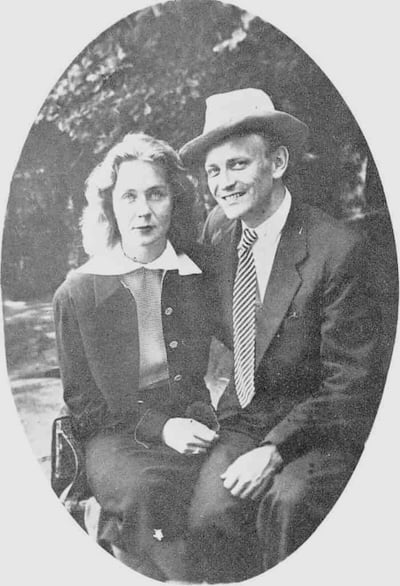
Ditlevsen with fourth husband Victor Andraesen in 1951
Photo courtesy of Wikimedia Commons
. . . . . . . . . .
A tumultuous personal life; multiple marriages
Ditlevsen married four times. Her first husband, Viggo F. Møller, whom she married in 1940, was the editor of Vild Hvede. They married three years after this journal published Ditlevsen’s poetry. She was twenty-two to his fifty-two; the marriage lasted just over a year.
She initially attributed her early literary success to Møller but later observed, “It probably wasn’t necessary to marry him to move up in the world, but no one had ever told me that a girl could make something of her own.”
After she and Møller divorced, she married Ebbe Munk in 1942. They had one daughter, Helle, born in 1943, but this marriage didn’t last much longer than the first. By 1945, she and Munk had divorced, and she married to Carl T. Ryberg, a physician. They had a son, Michael, born in 1946. Ryberg had a daughter, Trine, from a previous marriage.
This was a deeply unhappy time for Ditlevsen. She became addicted to prescription drugs (partly due to Ryberg, who supplied her with them), in particular Demerol. She nearly died before seeking treatment. In 1949, she was admitted to a psychiatric ward – the first of several brief in-patient stays.
In 1951, she married Victor Andraesen, the editor of the tabloid newspaper Ekstrabladet. This was the longest of her marriages, lasting for twenty years before ending in an acrimonious divorce.
. . . . . . . . . .
. . . . . . . . . .
The Copenhagen Trilogy
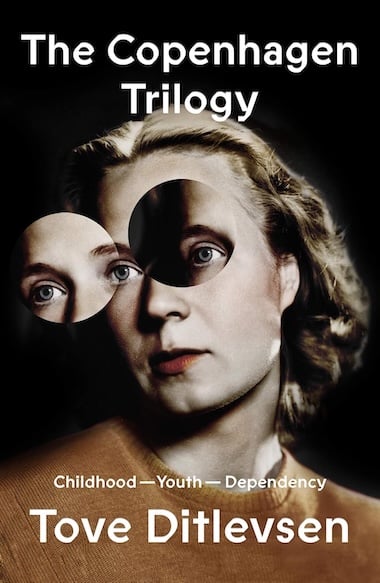
Much of Tove Ditlevsen’s work drew on her own experiences, and dealt with themes of love, class, addiction and mental illness, particularly as they pertained to women. Arguably the best-known example is the Copenhagen Trilogy, first published separately as Barndom (Childhood, 1967), Ungdom (Youth, 1967) and Gift (Dependency, 1971).
The trilogy charted her life from her childhood in Vesterbro through her teen years and early adulthood to marriage, childbirth, and addiction. Perhaps appropriately, Gift in Danish translates to both “married” and “poison” in English – an apt summing-up of how she experienced love. (Note, English editions of Gift are titled Dependency.)
The three books, however, aren’t a straightforward autobiography: scholar Sherilyn Hellberg pointed out that Ditlevsen was “constantly playing with this line between biography and fiction.” Today, the trilogy is often considered autofiction.
. . . . . . . . . .
. . . . . . . . . .
Poetry: “A girl’s dream”
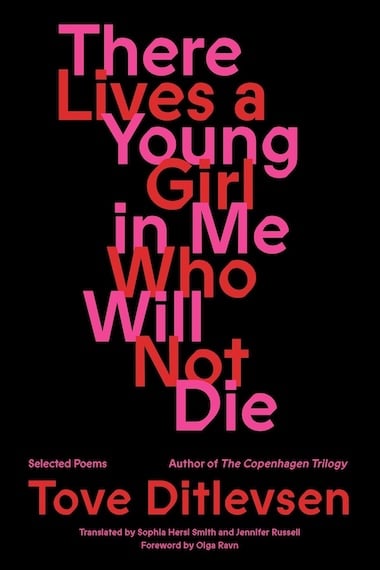
Tove Ditlevsen’s poetry was rich in themes similar to those in her prose works, particularly class and the role of women in society. The first collection to appear in English was There Lives a Young Girl in Me Who Will Not Die, translated by Sophia Hersi Smith and Jennifer Russell (2005).
In her poems, she often alluded to the “strange alienation” of housework and childrearing, and to her experiences of domestic abuse and illegal abortions. In the titular poem “There Lives a Young Girl in Me Who Will Not Die,” she wrote, “You had a girl’s dream of a husband and baby, / and you got what you wanted but were still alone.”
In the 1955 poem “Marriage,” she summed up her view of married life as “unknowingly coerced / into a lawful death of love.”
Her poetry was often critiqued as old-fashioned. She continued to write in rhyming verse well into the 1960s, while many of her contemporaries were shifting the poetic form into something freer and less rigid. In a 2005 TV interview, the author Klaus Rifbjerg commented, “She wrote rhyming poems, which were well crafted and well formulated, but were a kind of corset she had squeezed herself into…”
Another Danish author and poet, Olga Ravn, however, has argued that the subjects of Ditlevsen’s poems weren’t seeking anything new. Rather, they sought:
“… to review what has been cast off by tradition, the poetic scraps on the garbage heap. Why do they want to do that? Because using an archaic register is a working-class poet’s middle finger to the hoity-toity modernists and, at the same time, a way of resurrecting discarded language. With this discarded language, it’s possible to express an experience that cannot be articulated in the prevailing forms.”
“A worker’s writer”
Ditlevsen never self-described as a feminist, yet has been labelled a “woman’s writer” who, according to Dorthe Nors, is “loved by generations of women and put down by generations of men … [She is] the Billie Holiday of poetry… her prose turned the dreams and disappointments of life as a woman inside out.”
Olga Ravn notes Ditlevsen’s commitment to working-class literature:
“The revolutionary subject has always been presumed to be the man at the factory. But when women bring children into the world, children who grow up to go to the factory, work is being done… Hence, women’s literature about their own bodies and housework is workplace literature. Tove Ditlevsen was a worker’s writer.”
Despite achieving fame in her lifetime (she regularly appeared in newspapers and magazines for interviews and photoshoots), her place in the literary canon has long been disputed. According to Sherilyn Hellberg, Ditlevsen has,
“… been largely overlooked in this very male, very European tradition of modernism… Just talking about reading her seems to inspire all these really strong emotional reactions. There were all these debates about should Ditlevsen actually be read and was she worthy of being an object of literary criticism. It was really bizarre but also fascinating.”
Ditlevsen received many literary prizes, including De Gyldne Laurbær (The Golden Laurel) prize in 1955, a prestigious award bestowed by booksellers. Yet she still felt rejected by the literary establishment, particularly by the Danish Academy — she was never offered membership or its annual award.
Tove Ditlevsen took her own life at the age of fifty-eight by overdosing on sleeping pills. Photographs of her funeral show a crowd of working-class women following behind her coffin through the streets of Copenhagen.
. . . . . . . . . .
Contributed by Elodie Barnes. Elodie is a writer and editor with a serious case of wanderlust. Her short fiction has been widely published online and is included in the Best Small Fictions 2022 Anthology published by Sonder Press. She is Books & Creative Writing Editor at Lucy Writers Platform, she is also co-facilitating What the Water Gave Us, an Arts Council England-funded anthology of emerging women writers from migrant backgrounds. She is currently working on a collection of short stories, and when not writing can usually be found planning the next trip abroad, or daydreaming her way back to 1920s Paris. Find more of her writings here and on Literary Ladies Guide.
. . . . . . . . . .
More about Tove Ditlevsen
Major Works
Ditlevsen was quite prolific. Relatively few of her works have been translated to English from their original Danish. Her first book, a collection of poems, was published in 1939; her last, also a collection of poems, was published in 1978. Here is her full bibliography.
English translations:
- Childhood, Youth, Dependency: The Copenhagen Trilogy
(1967–1971; first published in English translation in 2019) - There Lives a Young Girl in Me Who Will Not Die: Selected Poems
- Vilhelm’s Room (a novel)
- The Trouble With Happiness and Other Stories
- The Faces (a novel)
Further reading
- The Image of the Doll: Tove Ditlevsen’s Worn-Out Language
(The Paris Review) - Tove Ditlevsen’s Art of Estrangement (The New Yorker)
- Overlooked No More: Tove Ditlevsen, Danish Writer
of Confessional Autofiction (New York Times)
Leave a Reply