Miriam Karpilove, Yiddish-Language Writer
By Elodie Barnes | On January 22, 2026 | Comments (0)
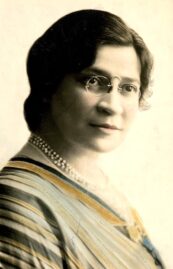
Miriam Karpilove (1888 – 1956) was a Belarus-born immigrant writer of fiction in the Yiddish language, best known for Diary of a Lonely Girl (1918).
Photo at right: Miriam Karpilove, from the collection of David Karpilow.
Karpilove became well known for her serialized novels in the American Yiddish press, focusing on the lives of young Jewish women and exploring contemporary issues of gender roles, sexual mores, immigration, and cultural dislocation.
Early life and emigration from Belarus
Karpilove was born in a small town near Minsk, Belorussia (now Belarus) in 1888, though the exact date is unknown. She was the fifth of ten children in an observant household. Her father, Elijah, was a lumber merchant and builder. Her mother, Hannah, encouraged the secular and religious education of all their children, including the girls.
Karpilove was an early lover of literature, especially Russian, and composed her own poetry in the language. She trained as a photographer and photographic retoucher.
She emigrated to the US in 1905, one of thousands of Jews who were fleeing the Russian Empire as a result of economic hardship, antisemitic pogroms, and restrictions on Jewish life under Tsarist rule. She settled in New York City, among the growing communities of Eastern European Jews on the Lower East Side, and supported herself with work in a photography studio. Some of her brothers, who also emigrated, settled in Bridgeport, Connecticut.
Writing life in New York
Karpilove published her first writing in 1906, in the Yiddish newspaper Di idishe fon. This was the start of a fifty-year career during which she wrote short stories, novels, novellas, sketches, criticism, and play scripts.
Nearly all her work appeared in Yiddish newspapers and periodicals such as Tog, Kibitser, Forverts, Yidisher Kemfe, and Fraye Arbeter Shtime, and more than twenty of her novels were serialized (only five appeared in book form in her lifetime).
The Yiddish press, like the wider American press at that time, was largely male dominated. Karpilove was one of the very few women able to make a living from writing. Her work was hugely popular with readers, particularly female readers, but was mostly ignored by (male) critics of the time.
Throughout her writing career, Karpilove explored American urban life from the perspective of Jewish women, often young and independent immigrants, and portrayed themes of emotional isolation, cultural dislocation, sexual vulnerability, and the rapid social changes of the period.
She was frank about romantic and sexual encounters, although virginity and marriage remained ideals for most of her heroines – not out of prudishness, but as a critique of the way the new social and sexual trends left women vulnerable and often exploited.
. . . . . . . . . .
. . . . . . . . . .
Diary of a Lonely Girl and other writings
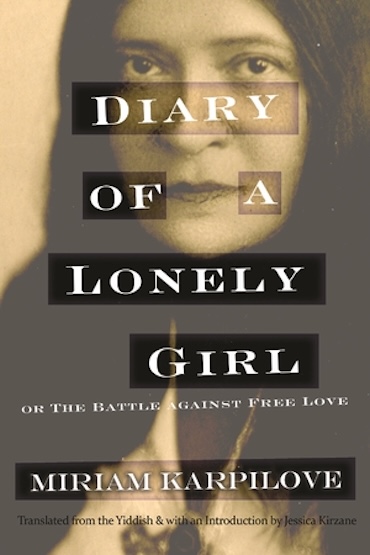
Her breakthrough novel, Tagebukh fun an elender meydele, oder Der kamf kegen fraye libe (Diary of a Lonely Girl, or the Battle Against Free Love) was serialized in Di Varhayt from 1916-1918, before being published in book form in 1918.
The story is told through the diary entries and letters of an unnamed protagonist as she writes, in wry detail, of her love life among the tenements of New York’s Lower East Side. She rejects both the idea of arranged marriages from the “old world culture” and “free love.” The latter, condoning extramarital affairs with no commitment, was advocated by the secular, radical Bohemians of the “new culture.”
The novel contrasts male entitlement with the lack of real autonomy for women, highlighting the disproportionate social and legal consequences that women could face as a result of men’s pursuit of “free love.”
Under the 1909 Tenement Act, for example, a woman could be evicted or arrested for prostitution simply for having a male visitor in her rented room. Unsurprisingly, there were no such consequences for the male visitors. In one diary entry, the protagonist writes, “If free is what you want, don’t force me.”
Similarly, Yudis (Judith) is an epistolary novel that explores the relationship between a small-town Jewish girl, uprooted by antisemitic violence, and her revolutionary lover Joseph. In her letters, Judith details the experiences and challenges faced by young Jewish immigrant women who move between old and new worlds and navigate shifting cultural ideas.
Karpilove often wrote from her own life experiences. Her 1909 play In di shturm teg (In the Stormy Days) drew on her childhood in the Russian Empire, while another serialized novel, A Provincial Newspaper (1926), explored an early-career female journalist’s struggles with overt sexism in the workplace.
From 1929 to 1937, she served as a staff writer for the renowned Yiddish newspaper Forverts. She published seven novels and several short stories there during that time, as well as reporting on current events, and contributing personal observations and opinion pieces on topics such as labor conditions and the culture of the Jewish community.
Travels to Palestine
Karpilove became active in the Labor Zionist movement upon her arrival in the US. Her brother Jacob, whom she was close to and who settled in Bridgeport, became a prominent Zionist leader in the Poale Tsion movement, and she was the secretary of the local chapter in New York.
In 1926, she traveled to Palestine, hoping to settle there permanently. Before departing (in something of a disorganized rush), she wrote to Chaim Liberman, Secretary of the Yiddish Writers’ Union:
“Yes, dearest of all secretaries, I am going to the land of Israel. I will be leaving in about a month, on the first of September, 1926 … My weak head is dizzy with all of the things that I have to do for myself in order to leave from golus [diaspora]. I am my own moshiyekh’te [lady messiah] and, as you know, I have no white horse and, as you also know, the subway is on strike to boot. Therefore please accept my apologies for my distance, my tardiness, in following the aforementioned rules and regulations …”
She returned from Palestine three years later, unable to make ends meet there. Her autobiographical novel A Novel About Israel: My Three Years in Israel chronicles her time there. It hasn’t been translated in full, but is held in her archive at the YIVO Institute for Jewish Research. An excerpt, translated by Jessica Kirzane, can be viewed here.
Karpilove wasn’t impressed with the British government mandate then in charge of the country. In the novel, she wrote of the government officials:
“They didn’t like us. I could tell. But we couldn’t ask them why…we just had to ignore their cold, dry demeanor towards us immigrants. I doubt if we’ll be able to accomplish much in Eretz Yisrael under the Mandate that they use to squeeze money out of us. We can only accomplish things that are in their interest. On the way to Eretz Yisrael, we heard our fill about their decency, but now all we could do was console ourselves with the hope that it won’t always be this way. Someday we’ll come to an agreement. We will prevail.”
. . . . . . . . . .
. . . . . . . . . .
Recent scholarly resurgence
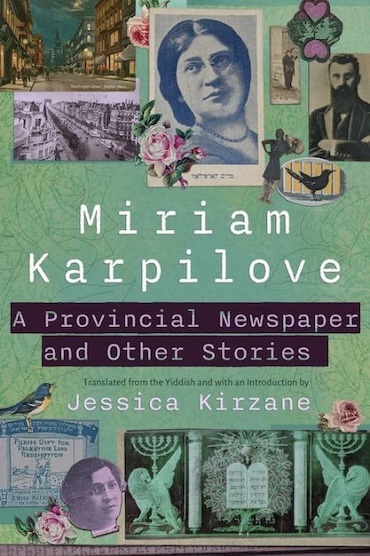
Karpilove has experienced a recent resurgence, thanks to the efforts of scholar Jessica Kirzane at the University of Chicago, whose translations have made her work more accessible. Syracuse University Press published Diary of a Lonely Girl, or the Battle for Free Love, in 2020, and A Provincial Newspaper and Other Stories in 2023. Judith: A Tale of Love and Woe was published by Farlag Press in 2022.
Karpilove kept scrupulous lists of what she wrote, where and when it was published. This makes it possible to get a fuller view of her writing life compared with other women’s, whose writing has been lost. Contemporary scholars place her as a sophisticated observer of Jewish women’s life: Kirzane says that Karpilove gives the reader “a provocative, audacious portrait of Jewish womanhood that maybe we wouldn’t get in the same way elsewhere.”
However, there is also an acknowledgement that in many of Karpilove’s short stories, particularly those written during and after her time in Palestine, there is a distinct element of racism and orientalism that was common among Westerners at the time.
Her narrators often portray Arabs in a negative light, blaming their own moral failings and not systemic or political failure. Critic Sarah Imroff, in reviewing Kirzane’s translation of A Provincial Newspaper, wrote that, “With no critique internal to the stories, it is difficult to conclude that Karpilove herself did not also hold some of these views.”
Kirzane, in her introduction, wrote that, “It is important to note Karpilove’s racism in the text, particularly because she sees herself as outside of the ideologically strident voices calling for the exclusive use of Jewish labor over Arab labor.”
Personal life and later years
Karpilove never married or had children. Among her family, she was closest to her brother Joseph, and around 1938, she moved from New York to Bridgeport to help him care for his ailing wife, Annie. She then stayed to care for Joseph after Annie died.
From postcards written in the 1940s to her friend and fellow Yiddish writer Bertha Kling. It can be gleaned that she desperately missed the bohemian atmosphere of Yiddish New York and the gatherings at Kling’s home that she would once have been a part of.
She wrote that if she had still been in New York, she would not have missed a single meeting, and said, “I think it’s long overdue that women writers should have the chance to hear each other. The power has been in the hands of male writers for too long.”
In her later years, she suffered from ill health, although there are no specifics on record. She died in Bridgeport in early 1956, with various sources citing March or May.
Her great-nephew, David Karpilow, remembered her as “a woman ahead of her time … a strong feminist, an early beatnik…unique within the family. I recall her reading a lot and having strong opinions … she was an intellectual, certainly in her own way. Her experiences were vast.”
. . . . . . . . . .
Contributed by Elodie Barnes. Elodie is a writer and editor with a serious case of wanderlust. Her short fiction has been widely published online and is included in the Best Small Fictions 2022 Anthology published by Sonder Press. She is Books & Creative Writing Editor at Lucy Writers Platform, she is also co-facilitating What the Water Gave Us, an Arts Council England-funded anthology of emerging women writers from migrant backgrounds. She is currently working on a collection of short stories, and when not writing can usually be found planning the next trip abroad, or daydreaming her way back to 1920s Paris. Find more of her writings here and on Literary Ladies Guide.
Further reading
Three books are available in English, all translated by Jessica Kirzane:
- Diary of a Lonely Girl, or the Battle for Free Love (Syracuse University Press, 2020)
- Judith: A Tale of Love and Woe (Farlag Press, 2022)
- A Provincial Newspaper and Other Stories (Syracuse University Press, 2023)
More about Miriam Karpilove
Leave a Reply