Lizzie Magie: Forgotten Inventor of The Landlord’s Game
By Evan Atlas | On June 5, 2026 | Updated June 15, 2026 | Comments (0)

Introduction by Literary Ladies Guide: Although Monopoly is one of the most iconic board games in the world, the fascinating story of its origins has been lost to time. First published by Parker Brothers in 1935, the game’s invention was long credited to Charles Darrow, a salesman. But Monopoly was actually based on The Landlord’s Game, invented and patented by Lizzie Magie in 1904.
The usurping game is now the best-selling modern board game, by far, with approximately 285 million copies sold. Its digital equivalent, Monopoly Go!, has amassed 150 million downloads, with millions of daily active users.
Some history of Lizzie Magie and her invention is explored in the following piece by Evan Atlas, who recently reimagined Magie’s creation as an online game called Prosperity.
. . . . . . . . .
Lizzie Magie and The Landlord’s Game
Contributed by Evan Atlas
Who Was Lizzie Magie? She was a champion of prosperity. That’s the short version. But this incredibly multifaceted woman defies brief classification. Her path was one of iconoclasm and entrepreneurial creativity.
Elizabeth Jones Magie (1866 – 1948), born in Macomb, Illinois, was the daughter of James Kingsley Magie and Mary Jane Ritchie. Her father sparked her lifelong interest in economic justice by introducing her to Progress and Poverty, the groundbreaking book by Henry George. It not only inspired The Landlord’s Game, but stayed with her throughout her life.
. . . . . . . . . . .
. . . . . . . . . . .
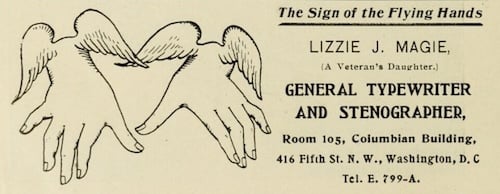
In her early twenties, Magie became a proficient typist and stenographer, even starting her own business centered on these skills. But she was anything but mechanical. At just twenty-six years of age, she secured her first patent for innovating the typewriters she had mastered.
Notably, it was a time when less than 1% of patents were issued to women. This was the engineering side of Magie. She both understood systems and had the inclination to change them:
“We are not machines. Girls have minds, desires, hopes and ambition.”
Artistically, she dabbled in writing, live comedy, and theatre. A collection of her poetry, titled My Betrothed, and Other Poems, reveals other varied interests such as psychology, philosophy, and squandered opportunity:
Society, thou ill-constructed thing,
Reform thyself!
Dethrone the worthless idlers!
Make room for worthy Genius!
O ye men of wealth and power,
Should this be so?
Should Genius, out of place,
Toil on till death, impoverished, unknown?
This poet soul, imprisoned, dreams away.
A thousand brilliant thoughts
Come rushing to his brain,
And, like some caged wild bird,
Flap their wings and cry for liberty,
But find it not,
And fade and die imprisoned.
Elsewhere, she displayed her literary talents as an investigative journalist, covering the grueling working conditions of women. She was a vocal feminist throughout her life, and gained notoriety for placing a satirical ad for “herself” in a newspaper:
“Young woman American slave to the highest bidder: Intelligent, well-educated, refined, true, honest, just, poetical, philosophical, and womanly above all things. Brunette, large gray-green eyes, full passionate lips, splendid teeth, not beautiful but very attractive, features full of character and strength, yet truly feminine; height 5 feet 3 inches; well proportioned, graceful.”
But near the end of her life, she listed her occupation as maker of games.
. . . . . . . . . . .
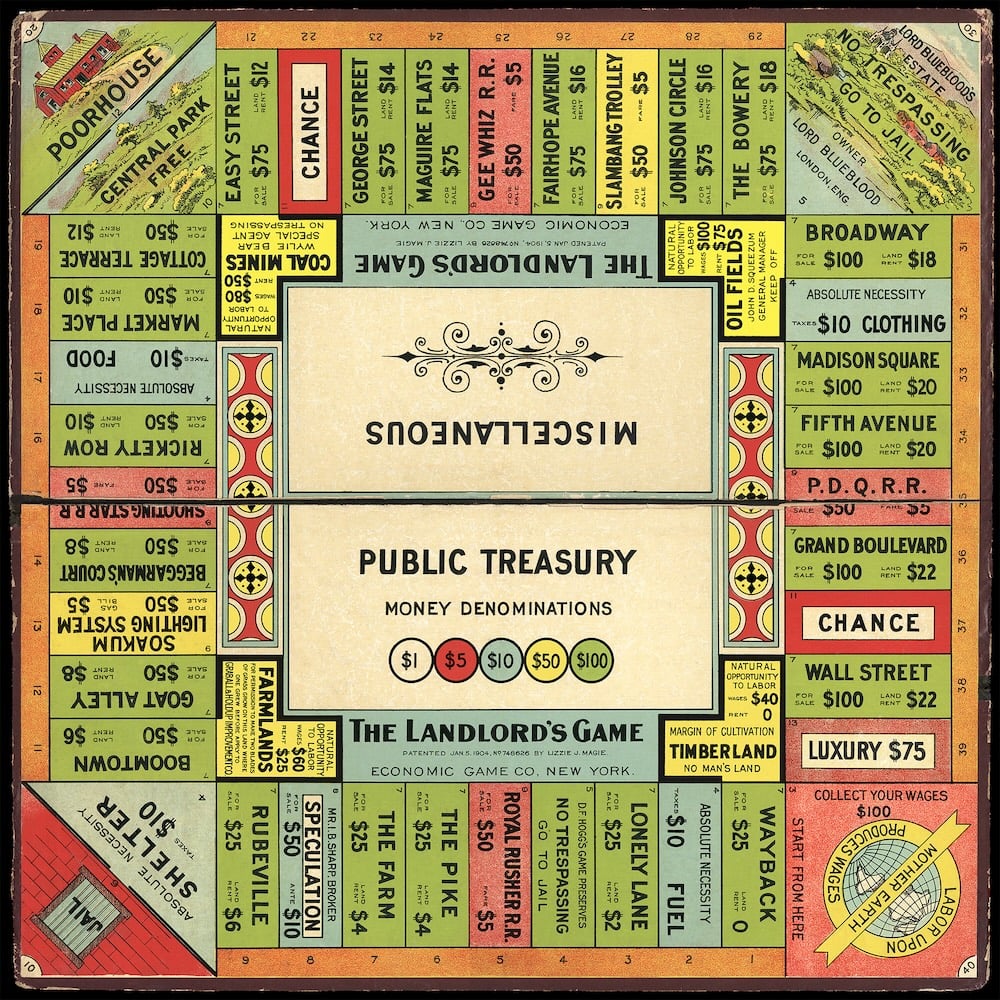
Magie was awarded a patent for the Landlord’s Game in 1904
. . . . . . . . . . .
The Landlord’s Game
Many games have a philosophical aspect to them. It just so happens that Monopoly is more covert than its forgotten predecessor. Its style of play fits neatly within the prevailing economic orthodoxy, so it isn’t recognized as having a distinct philosophical stance. Yet it does. It subscribes to the practice of bundling together land rents and structure rents.
We can see this at work in both the game — and in daily life beyond the board. If I own a property (in Monopoly or in my home state of New York) that consists of land and a house that I built, I’ll be charged a property tax. This tax is based on the combined value of the land and the house.
Magie considered this an economic injustice. Why? Because my efforts and resources produced the value that results from constructing a house, but not the value that is inherent to the land. From this logic, the land value tax was born.
The value of land is a public good that is privately captured. So the remedy is to tax land at a rate that recaptures that value and effectively restores its status as a public good. This is the philosophy that inspired Lizzie Magie, and is the economic foundation of The Landlord’s Game.
She achieved this with a brilliant game rule that was later left out of Monopoly—the prosperity rule. It follows from the same logic explored above: It should be expensive, not profitable, to hoard undeveloped land. Monopoly, lacking this rule, was born as an ode to injustice. It was in 1935 that the Parker Brothers company bought the rights to her game for just $500.
This has been characterized as a swindle, understandably. But make no mistake: Magie was not duped into thinking that’s all the game was worth. What convinced her was not the $500—it was that they offered to sell and promote The Landlord’s Game along with Monopoly.
She truly believed this was how her Georgist board game would finally reach the wider world. Parker Brothers, however, did little to promote her game, and discontinued it shortly after it went into production. Since then, it has been mostly lost to time, with few having ever heard of it.
In her poem title “Self,” she wrote:
The great are those who make the world
The better by their deeds.
Her dream was buried. But she was true to herself to the very end. I think that Magie, as a maker of games, did a little wordplay here. Of course it is our actions (our deeds) that shape reality. It couldn’t have been far from her mind that the same could be said of our property deeds.
. . . . . . . . . . .
For the expanded version of this post,
see Prosperity: A Georgist Game
. . . . . . . . . . .
See (and Play) for Yourself
Lizzie Magie once said, “I am thankful that I have been taught how to think and not what to think.” That’s why sometimes we need games, not textbooks.
If you’re as inspired by Magie’s story and her lost board game as I am, you may be wondering where you can play The Landlord’s Game. That’s why I’ve re-imagined it as a modern online game called Prosperity. Play the game and see Lizzie Magie’s ideas clearly for yourself. With her help, we can change the world.
. . . . . . . . .
Contributed by Evan Atlas. Evan is a writer and political philosopher from New York’s Hudson Valley. His work confronts our most significant challenges, and develops a theory of change for the 21st century that is unlike anything you’ve heard before. He believes that the future of humanity can be more loving, more free, and more beautiful, but that this future is in danger. Join him at evanatlas.com and on his Substack and help create a more beautiful planet.
. . . . . . . . . . .

Lizzie Magie in 1906
Learn more in “The Woman Inventor Behind Monopoly“
Further reading
- Chokshi, Niraj. “A New Monopoly Game Celebrates Women, but What About the One Behind the Original?” International New York Times / International Herald Tribune. September 2019.
- Dodson, Edward J. “How Henry George’s Principles Were Corrupted Into the Game Called Monopoly.” December 2011.
- Edwards, Gavin. “Overlooked No More: Lizzie Magie, the Unknown Inventor Behind Monopoly.”
The New York Times. April 2024. - Terrell, Ellen. “The Very Fascinating Elizabeth J. Magie.” Library of Congress. September 2022.
Leave a Reply