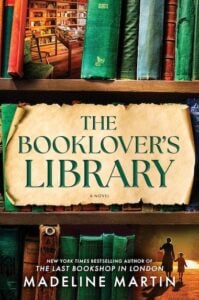
For those of us who love (or make that obsessed with) books, novels about books, bookstores, and libraries are the icing on the cake. Reading about books and bookish people in fictional narratives, might seem odd, but for the devout bibliophile, it makes perfect sense.
Presented here is a selection of contemporary novels whose stories are centered around bookstores or libraries. What could be cozier reading on a chilly day accompanied by a warm drink, a blanket, and a four-legged friend or two? Read More→
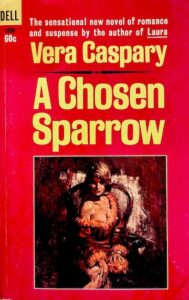
“You survived. That’s important.”
“But who am I? An insignificant girl with no great talent. Why was I the one to be saved?”
He smiled a little. “Haven’t you heard that God heeds each sparrow’s fall?”
So many sparrows fell. Was God watching? Did He count them? Why was I chosen to live?”
(from A Chosen Sparrow by Vera Caspary, 1964)
This in-depth look at A Chosen Sparrow by Vera Caspary is excerpted from A Girl Named Vera Can Never Tell a Lie: The Fiction of Vera Caspary by Francis Booth ©2022. Reprinted by permission. Read More→
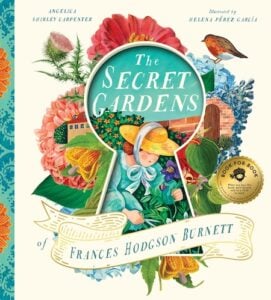
It’s never too soon to introduce young readers to classic authors. Angelica Shirley Carpenter’s The Secret Gardens of Frances Hodgson Burnett, a picture book biography (Bushel & Peck Books, 2024) does so in an immensely engaging way.
Vivid illustrations by Helena Pérez García that burst with colorful expression on every page. Angelica presents the story of Frances Hodgson’s insecure childhood on both sides of the Atlantic, and her challenges and triumphs as a writer.
Marrying Dr. Swan Burnett, having two sons, experiencing triumph as well as hardships and tragedies and writing through it all is part of the fascinating story of this author’s life. Frances’s story is one of perseverance, finding moments of joy in complicated circumstances, and the solace of creative pursuit. Read More→
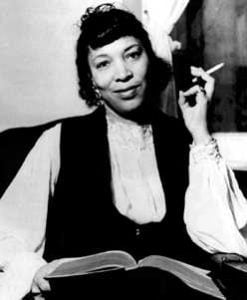
“How it Feels to Be Colored Me” is an essay by Zora Neale Hurston originally published in the 1928 edition of The World Tomorrow. She explores her unique experience with race in her customary wry, forthright manner.
Zora makes clear that she speaks only for herself, as the tone of this essay doesn’t necessarily reflect the more proudly propagandist Black writing that characterized the 1920s New Negro movement (also known as the Harlem Renaissance.
Yet she clearly critiques the rampant segregation and bias that were woven into the fabric of American life, North and South. Following is the full text of “How it Feels to Be Colored Me,” now in the public domain. The only alteration to the text has been to break up long paragraphs, for easier readability on devices. Read More→
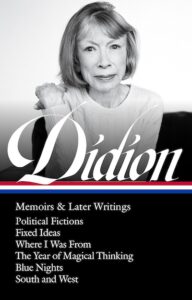
Gonzo journalism is a writing style strongly associated with Tom Wolfe and Hunter S. Thompson. However, others have contributed their voice to immersive journalism since the genre’s earliest roots in New Journalism.
Here we’ll explore the work of Joan Didion, Gail Sheehy, and Barbara Ehrenreich in this context as three impactful female gonzo journalists.
Where the author becomes central to the story or investigation is an example of immersive or gonzo journalism. Read More→
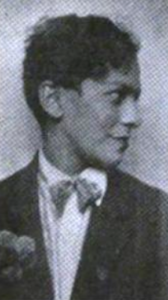
Mae Virginia Cowdery (also known as Mae V. Cowdery; January 10, 1909 – November 2, 1948) is a forgotten poetic voice of the Harlem Renaissance era of the 1920s. A selection of her earlier poems is presented here.
Mae was the only child of professional parents who were part of Philadelphia’s Black elite. They instilled in her their values of racial pride, equality, and respect for the arts.
Above right, Mae in 1928 at age nineteen, sporting an androgynous look.
Read More→
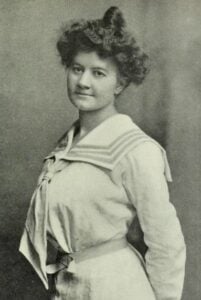
Ellen Glasgow (April 22, 1873 – November 21, 1945) was one of the South’s most eminent writers of her day. Today she’s far less known than contemporaries like Edith Wharton and Willa Cather, despite having created an impressive body of work.
Ellen’s output included novels, collections of short stories and poems, a treatise on how to write fiction, and an autobiography. She was also the recipient of the Pulitzer Prize in 1942. Today, if she is remembered for anything, it’s more for her influence than her literary talent.
It’s well worth rediscovering this often overlooked writer.
Read More→
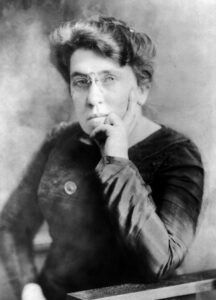
Emma Goldman (1869 – 1940) was a noted political activist and promoter of the anarchist philosophy. She was best known for her role in the development of its theories in the early twentieth century.
As such, “Anarchism: What it Really Stands For” is a 1911 essay that crystalizes her views. Anarchism, in brief, argues against all forms of authority the abolishment of institutions of government, advocating for replacing them with stateless societies.
Goldman’s views seem particularly resonant — and relevant — in this age of government overreach into privacy and personal freedom. Read More→