Olga Ivinskaya, poet, literary translator & Boris Pasternak’s muse
By Marie Lebert | On September 30, 2026 | Comments (0)
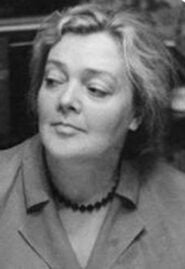
Russian poet Olga Ivinskaya (1912–1995) is remembered as Boris Pasternak’s friend and lover, and the inspiration for the character of Lara in Doctor Zhivago (1957). She was also his co-translator for contemporary poetry collections.
Olga Ivinskaya was instrumental in getting Doctor Zhivago published in Italy and in other countries after Pasternak (1890 – was unable find a publisher in Russia. She was imprisoned in a labor camp for several years because of her relationship with Pasternak and involvement in the publication of the novel.
Ivinskaya was one of the nine prisoners of conscience who led to the creation of Amnesty International in 1961.
Early life and career
Born in Tambov in central Russia in 1912, Olga Ivinskaya, of German-Polish descent, moved to Moscow with her family in 1915. After graduating from the Editorial Workers Institute in 1936, she worked as an editor for various literary magazines.
She married twice, first in 1936 to Ivan Emilianov, who hanged himself in 1939. Her second marriage was in 1941 to Alexander Vinogradov, who was killed at the front in 1943 during World War II. She had a daughter (Irina Emelianova) with Ivan Emilianov and a son (Dmitry Vinogradov) with Alexander Vinogradov.
An admirer of Russian poet Boris Pasternak since her adolescence, Ivinskaya regularly attended literary gatherings to listen to his poetry. Pasternak was already famous for his poetry collections My Sister, Life (1922), The Second Birth (1932) and subsequent works.
Ivinskaya became acquainted with him in 1946 when she was in charge of the new authors department at the editorial office of the monthly literary journal Novy Mir. She became his friend and lover (he was divorced and remarried, with two sons) from 1947 until his death in 1960.
Ivinskaya’s literary translations with Boris Pasternak
Fluent in several languages, Pasternak was a prominent literary translator. He did this work to provide for his family, because like many Russian authors, he was affected by the Soviet crackdown on their writings. He did translations of stage plays by William Shakespeare as well as by German playwrights Goethe and Friedrich Schiller, and Spanish dramatist Calderón de la Barca. His translations were popular with Russian audiences because of their colloquial and modernized dialogues.
Pasternak also translated 19th-century poetry collections by French poet Paul Verlaine, Hungarian poet Sándor Petőfi, Polish poet Juliusz Słowacki, Ukrainian poet Taras Shevchenko, and Georgian poet Nikoloz Baratashvili. He also translated poems by his friend the Austrian poet Rainer Maria Rilke.
Because of her relationship with Pasternak, Ivinskaya gave up her job at the literary journal Novy Mir in 1948. She became his literary assistant and worked closely with him to translate 20th-century poetry collections into Russian, including those of Bengali poet Rabindranath Tagore and Czech poet Vitĕzslav Nezval, an avant-garde writer (and translator) who participated in the Surrealist movement.
. . . . . . . . . .
. . . . . . . . . .
Boris Pasternak’s Doctor Zhivago
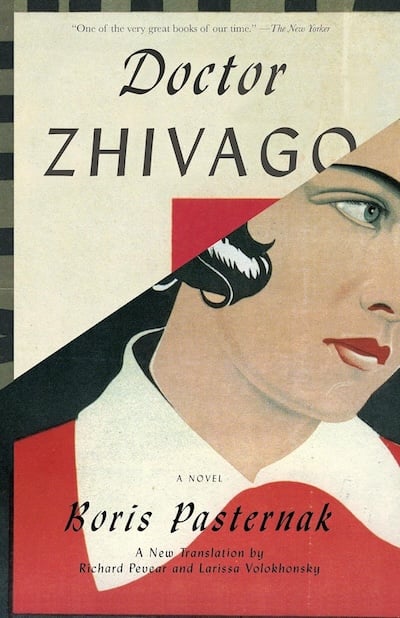
Olga Ivinskaya was the inspiration for the character of Lara in Doctor Zhivago (1957). Following the eponymous protagonist, physician and poet Yuri Zhivago, the novel spans more than forty years, from 1902 (at the time of Imperial Russia) to 1943 (during World War II). It encompasses the 1917 Russian Revolution, Civil War (1917 – 1922), rise of the Soviet Union (1922), and the Great Purge (from 1936 to 1938).
Pasternak spent many years writing this complex, multi-layered novel with a number of plot lines and themes. Yuri Zhivago is torn between his obligations to his wife and his consuming passion for Lara he encounters at war.
Often described as semi-autobiographical, the novel is a powerful depiction of a turbulent period in Russian history. and the harsh realities of Soviet life as experienced by Pasternak. The novel includes several poems originally written by Pasternak for Olga.
Doctor Zhivago novel was submitted in 1956 to the literary journal Novy Mir. The editors refused to publish it because of Pasternak’s rejection of socialist realism and its communist values with society prioritized over individuals. Some parts about Stalinism (Joseph Stalin ruled the country from 1922 to 1953), Collectivization (the Soviet system of state-controlled farms) and the Gulag (the Soviet system of labor camps) were deemed anti-Soviet by censors.
Dr. Zhivago’s publication in Italian, French, German and English
Pasternak sent copies of the manuscript to some friends in the West. In 1957, he gave the manuscript in 1957 to Italian journalist Sergio d’Angelo to smuggle it out of the Soviet Union and deliver to Giangiocomo Feltrinelli, an influential publisher and political activist living in Milan, Italy.
Ivinskaya was instrumental in the publication of Dr. Zhivago, and conducted all the negotiations on Pasternak’s behalf. Feltrinelli resisted all efforts by the Soviet government and the Italian Communist Party to cancel its publication. Doctor Zhivago was first published in 1957 in an Italian edition (translated by Italian literary critic Pietro Antonio) that quickly became a bestseller.
Pasternak, who was writing his correspondence in French (including with Feltrinelli) to escape Soviet censorship, was eager to see a French edition as well. The novel was translated by French slavic scholars Michel Aucouturier, Louis Martinez, Hélène Peltier-Zamoyska and Jacqueline de Proyart. The French edition was published in 1958 by Gallimard in Paris shortly after the Italian edition.
A German edition (translated by German translators Reinold von Walter for the main work and Rolf-Dietrich Keil for the embedded poems) was published in 1958 by S. Fisher Verlag in Frankfurt am Main, after the French edition and before the English edition.
An English edition (translated by British lecturer Max Hayward and British translator Manya Harari) was published in 1958 by Collins and Harvill Press in London, and by Pantheon Books in the United States. It spent six months on the New York Times bestseller list.
The first Russian-language edition of Dr. Zhivago
Dr. Zhivago was banned in the Soviet Union. The first Russian-language edition was illegally printed in 1958 by Mouton Publishers in The Hague, Netherlands, probably from photographs of the typescript by British intelligence officials.
The novel was printed with the backing of the CIA (Central Intelligence Agency) that secretly organized and funded the publication of around one thousand hardback copies (as confirmed in 2014 in declassified documents) with Mouton’s trademark blue cloth binding and the imprint of legitimate publisher Feltrinelli (who didn’t know about the print run) on the title page.
The purpose of the print run was to distribute some copies to Soviet visitors at the 1958 Brussels World’s Fair in Belgium, and to distribute many more copies to Soviet visitors and officials staying in European capitals (who might smuggle a copy back into the Soviet Bloc) in order to undermine the Soviet government and counteract Soviet censorship.
Feltrinelli threatened legal action when he learned about the illegal print run. Mouton Publishers agreed to an indemnity obligation to print an additional five thousand legitimate copies for Feltrinelli.
Feltrinelli was also able to license the translation rights into many other languages and to sell the movie rights to Italian film producer Carlo Ponti.
Pasternak’s Nobel Prize in Literature
Boris Pasternak was awarded the Nobel Prize in Literature in 1958 “for his important achievement both in contemporary lyrical poetry and in the field of the great Russian epic tradition.”
He sent a first telegram accepting the award and a second telegram declining it under pressure by the Soviet government. Even after declining the award, he was demonized by the Soviet Union of Writers, who expelled him from the Union.
His poetry disappeared from bookstores and from public view. His translations of European plays were pulled from theaters, and he couldn’t find translation work anymore. He was repeatedly defamed by the Soviet press and shunned by many of his peers. Olga Ivinskaya stood firmly by his side during the ordeal and persecution.
The Soviet government also threatened him with exile to the West, which was his worst fear. Pasternak replied in a letter to Nikita Khrushchev (who ruled the country from 1953 to 1964): “For me this is impossible. I am tied to Russia by birth, by my life and work. I cannot conceive of my destiny separate from Russia, or outside it.” (cited in Olga Ivinskaya’s A Captive of Time: My Years with Pasternak, 1978).
A Russian-language edition of the novel was once again printed in 1959. The imprint of the paperback pocket-size edition (for it to be easily smuggled) was the Société d’Édition et d’Impression Mondiale (Global Company for Publishing and Printing), a fictitious French publisher invented by the CIA to cover its tracks (as confirmed in 2014 in declassified documents).
More than nine thousand copies were printed, with seven thousand handed to Soviet tourists and officials who might smuggle a copy back into the Soviet Bloc. Two thousand copies were distributed at the World Festival of Youth and Students held in Vienna, Austria.
The purpose was again to undermine the Soviet government and to counter Soviet censorship by disseminating the work of a prominent Russian author who had just been awarded the Nobel Prize in Literature, censored in his own country. The Cold War (a long period of political tension between the United States and the Soviet Union) was the background.
A legitimate Russian-language edition was published in 1959 by the University of Michigan Press in the U.S., after Feltrinelli granted them license to the to proceed with publication. It was followed by the publication of a Russian-language edition of Pasternak’s Poems (1959) and Collected Works (1961). The Library Special Collections now include the University of Michigan Press Pasternak Records, 1958–1988, with the bulk of the records dated 1959—1962.
. . . . . . . . . .
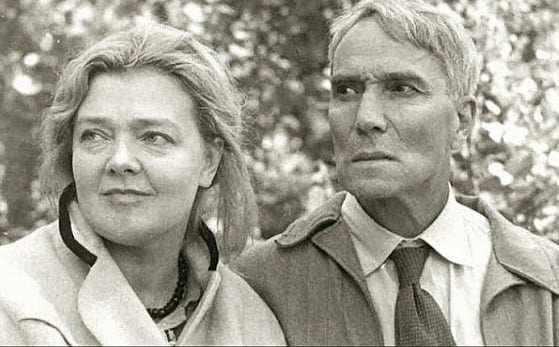
Unattributed and undated photo of Ivinskaya and Pasternak,
possibly late 1950s or early 1960s
. . . . . . . . . .
Olga Ivinskaya’s imprisonment
Due to her relationship with Pasternak, Olga Ivinskaya was arrested in 1949 and imprisoned in a labour camp (Gulag) for four years. At the time of her arrest, she was pregnant by Pasternak, and miscarried.
She was released in 1953 after Joseph Stalin’s death. In a 1958 letter to a friend in West Germany, Pasternak wrote of Ivinskaya:
“She was put in jail on my account, as the person considered by the secret police to be closest to me, and they hoped that by means of a grueling interrogation and threats they could extract enough evidence from her to put me on trial. I owe my life and the fact that they did not touch me in those years to her heroism and endurance.” (cited in Olga Ivinskaya’s A Captive of Time: My Years with Pasternak, 1978).
Ivinskaya was imprisoned in a labour camp for a second time from 1961 to 1964, after Pasternak’s death in 1960, for the first two years with her daughter Irina Emelianova.This time she was accused of receiving foreign royalties in hard currency from the western publishers of Doctor Zhivago.
The Soviet media orchestrated a smear campaign accusing her of accepting roubles and dollars smuggled past customs and of swindling Pasternak’s rightful heirs (according to Ivinskaya’s 1995 obituary in the British newspaper The Independent).
All of Pasternak’s letters to Ivinskaya, along with other manuscripts and documents, were seized by the KGB (the main Soviet security agency from 1954 to 1991). She served four years of an eight-year sentence. She was one of the nine prisoners of conscience (imprisoned for peacefully expressing their views) featured in the book Persecution 1961 by British lawyer Peter Benenson, who founded the human rights group Amnesty International the same year.
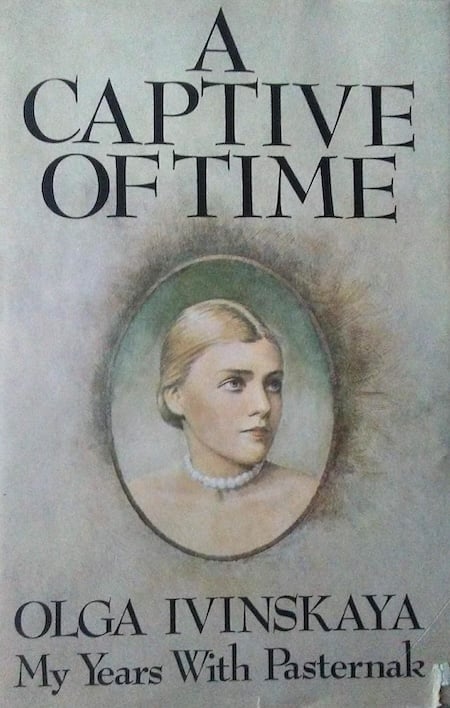
Written in the 1970s, Olga Ivinskaya’s memoir was smuggled out of Russia. The Russian-language edition was published in 1978 by Fayard in Paris. The English edition (translated by British lecturer Max Hayward, who, as mentioned earlier, co-translated Doctor Zhivago in 1958) was published as A Captive of Time: My Years with Pasternak (1978) by Collins and Harvill Press (London), and by Doubleday (New York).
Ivinskaya was rehabilitated in 1988 by Mikhail Gorbachev (who ruled the country from 1985 to 1991) as part of his Glasnost (transparency) campaign for decreased censorship and greater freedom of information.
. . . . . . . . . .
. . . . . . . . . .
Life after Dr. Zhivago
Boris Pasternak died of lung cancer in 1960 at the age of seventy, two years after declining the Nobel Prize in Literature. Under heavy surveillance by the KGB, his funeral was attended by his wife Zinaida Pasternak, and his two sons, Evgeny and Leonid Pasternak. His friend and lover Olga Ivinskaya was also in attendance, along with many literary figures and artists and more than one thousand admirers, in a silent act of public dissent.
The 1965 film adaptation of Doctor Zhivago by legendary English filmmaker David Lean won five Academy awards and became one of the highest-grossing and critically acclaimed films of all time.
Doctor Zhivago wasn’t published until 1988 in the Soviet Union, thirty years after the first Russian-language print run in 1958. It was serialized across five issues in the literary monthly thick journal Novy Mir, the same journal that had employed Olga Ivinskaya until 1947 and that had refused to publish Pasternak’s novel in 1956. American journalist David Remnick wrote:
“What was really incredible in 1988 and 1989 was to ride the subways and see ordinary people reading Pasternak in their sky-blue copies of Novy Mir. For a couple of years, stokers, drivers, students, everyone consumed this material with an animal hunger. They read all the time, riding up escalators, walking down the streets, reading as if this would all disappear once again into the censor’s black box” (from Lenin’s Tomb: The Last Days of the Soviet Empire, 1994).
Pasternak’s son Yevgeny Pasternak traveled to Oslo, Norway in 1988 to belatedly accept the Nobel Prize in Literature on behalf of his father.
Ivanskaya’s memoir was published in 1992 in Russia, by Libris in Moscow, fourteen years after the first Russian-language edition by Fayard in Paris. Despite spending several years in litigation, Ivanskaya couldn’t regain Pasternak’s letters to her. They had been seized by the KGB during her second arrest in 1961 with other manuscripts and documents.
Olga Ivanskaya died of cancer in Moscow in 1995 at the age of eighty-three. Her daughter Irina Emelianova, who emigrated to France in 1985, wrote a memoir about her childhood in Moscow, her mother’s relationship with Pasternak, and the brutal Soviet persecution they endured. The Russian edition was published in 1997 by Ellis Lak in Moscow.
The French edition (translated by French professor Gérard Abensour) was published in 2002 by Fayard in Paris as Légendes de la rue Potapov (Tales of Potapov Street — that being the street where they had lived in Moscow. It was republished in 2020 by Éditions des Syrtes in Geneva, Switzerland. An English edition doesn’t seem to be available as of yet.
The involvement of the CIA in the first Russian-language print runs of Doctor Zhivago (in 1958 and 1959) was confirmed in 2014 in more than one hundred declassified documents. The memos, letters and cables showed how the novel was used as a Cold War propaganda tool to undermine the Soviet Union. The documents were declassified following a request by Peter Finn (an American journalist and editor) and Petra Couvée (a Russian writer and translator) as part of their research for their book The Zhivago Affair: The Kremlin, the CIA, and the Battle Over a Forbidden Book, published by Pantheon Books in 2014.
. . . . . . . . . .
Contributed by Marie Lebert. Marie is a French translator who has worked for international organizations and global projects in several countries. She writes about translation and translators past and present with a focus on women translators who have been forgotten or overlooked, and who were also writers. Marie holds a PhD in linguistics from the Sorbonne University and an MPhil in social science from the University of Caen Normandy. Her articles, essays and ebooks are available online in English, French, and Spanish at Marie Lebert. Explore more entries by Marie Lebert, most profiling translators, on Literary Ladies Guide.
Further reading
- Doctor Zhivago by Boris Pasternak (1957)
- A Captive of Time: My Years with Pasternak by Olga Ivinskaya (1978)
- Lenin’s Tomb: The Last Days of the Soviet Empire by David Remnick (1994)
- The Zhivago Affair: The Kremlin, the CIA, and the Battle Over a Forbidden Book
by Peter Finn and Petra Couvée (2014) - Lara: The Untold Love Story and Inspiration for Dr. Zhivago by Anna Pasternak (2017)
Leave a Reply