Shirley Hazzard – on Travel, Love, and Language
By Chris Prickett | On July 20, 2026 | Updated July 24, 2026 | Comments (2)
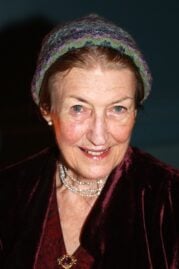
Like many of the main characters in her novels, Australian-American writer Shirley Hazzard (1931–2016) traveled and moved homes from a young age. At first, this relocation was due to the decisions of parents responding to work or world events, and later to the dictates of her employers.
Photo at right, Shirley Hazzard in 2007, photo by Christopher Peterson. Courtesy of Wikimedia Commons.
Hazzard’s Free Travelers
In her short stories, we sometimes see tourists and travelers who visit of their own free will—for the sake of it. And those who fall in love with a place that may nurture them even more than a human they had the poor luck to fall in love with.
Hazzard’s fiction, therefore, is a neat fit for those who love to travel and for those (like me) who have also moved all their lives. Across her writing and interviews, a taxonomy of travel emerges. There are the Bell sisters in The Transit of Venus (1980), who are simply happy to have arrived in England from Australia, as Shirley Hazzard had.
Less worried than their new English friends and mentors about the work they must get, they feel that they’ve accomplished their triumphant objective: arriving. This IS the project, what they’ve long planned to do: Getting here. Victory is theirs from the beginning. And this is one way we travel.
. . . . . . . . . .
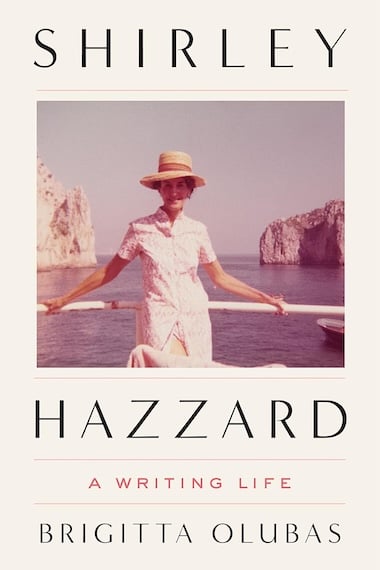
Learn more about Shirley Hazzard
. . . . . . . . . .
Hazzard’s Grumpy Travelers
But Hazzard depicts other types of travelers, who neither love nor assimilate into the places in which they’ve arrived. A character in a short story (“Harold,” 1962) learns not a single phrase of Italian while studying cello in Siena for the summer. “She spoke of England with a longing as constant as though she had been condemned to exile.”
The Fenwicks, a couple in Hazzard’s first story collection, “had been gratified to find so many forebodings justified” on their first visit from England to Italy. They don’t know what to make of the Italian sky, however, which was “not their King James version sky.”
Shirley Hazzard, we begin to see, is a master of literary snark, nailing a character with a phrase that captures their worldview, or simply the way they’ve capitulated to their bureaucratic environment. If Cliffs of Fall, her first story collection, focuses on a range of romantic entanglements, her second collection, People in Glass Houses, surveys how people thrive, are corrupted, or barely survive working in massive institutions:
“Tong was beaming. ‘Some bad news, yes.’ Not naturally malicious, he had developed rapidly since entering bureaucracy.” Another character is back from the field in Africa: “Flinders had no complaint, making him an object of curiosity.”
Against characters like these, Hazzard pits Lidia, a translator, who quotes Bakunin: “I shall continue to be impossible so long as those who are now possible remain possible.”
In the short story, “The Flowers of Sorrow” (1964), the Director General of an organization delivers a speech to its members. Everyone feels that he has gone off script, confused when he says: “Will the flowers of joy ever equal the flowers of sorrow? But we should remember that sorrow does produce flowers of its own. It is a misunderstanding to always look for joy.”
Perhaps no lines best encapsulate Hazzard’s view than these, so randomly delivered to members of the Organization (a thinly veiled name for the United Nations, where she worked for many years). Whether regarding love, work, or travel, Hazzard focuses on what we embrace or miss. Sure, the speech is flowery, especially for a bureaucrat. But it also spans across Hazzard’s main theme that it’s better to have loved and lost — than the opposite.
. . . . . . . . . . .
. . . . . . . . . . .
Fortunately for Hazzard’s writing (and our reading), she was accepted for a post in Naples, just when her work life in New York had become grueling, and a love affair went sour. Unlike her future grumpy characters, the Fenwicks, she didn’t find that it satisfied her forebodings. She found it wonderful.
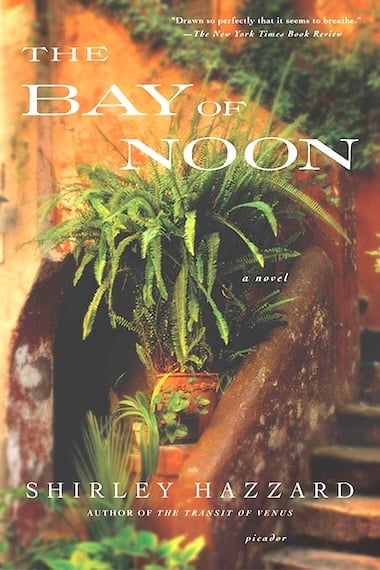
In Hazzard’s first novel, The Bay of Noon (1970), a rare book she wrote in the first person, she seems to echo the narrator, Jenny, in finding Naples an unexpected pleasure, an escape from the grind after a secretarial job in New York. In Naples, Jenny experiences the traveler’s joy in a new place that is as loved as it is nourishing for the soul.
Still, unlike Jenny, many of her colleagues settle into their work and lives as if they hadn’t moved anywhere. Again, we see how different travelers can be. Quickly, (unlike Hazzard and Jenny) they are moored in place, just accidentally in a place they no longer see.
. . . . . . . . . . .
. . . . . . . . . . .
No one is as susceptible to this as Graham Greene, who despite having lived in and written about many dangerous places now traveled “in Greeneland, bringing his world, including amore, with him.”
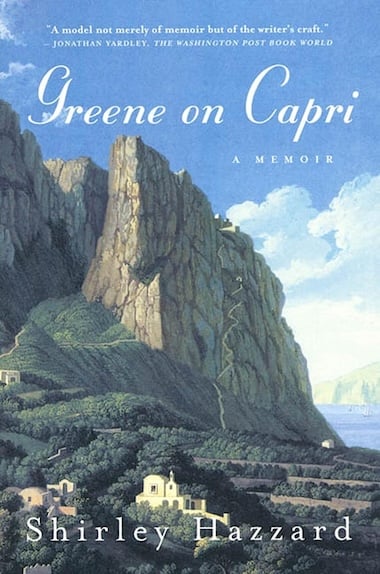
Like the Fenwicks (as Hazzard remarks in Greene on Capri, 2000), Graham Greene can also be something of a grumpy traveler. Observing an island in the bay between Capri and Naples, he remarks, “the place looks idyllic, but might be hell.” Hazzard notes that “Greene was inclined to suspect –in some moods, perhaps, to hope—that most idylls might be hell.”
Thus, certain travelers journey as if blind. Or travel grumpy. Perhaps even more so when amore is involved. In Greene on Capri, Hazzard tracks the history of travel at least from Britain to Italy and how for a certain class of people a visit was obligatory following the 18th-century discoveries of ancient Pompeii and Herculaneum.
She is grateful that she experienced Naples and Capri before the floods of tourists arrived, when Capri was a destination for those who sought a warm climate for their health and, “still other travelers came in retreat from the disapproval of society: unwed lovers, homosexual partners, and, less commonly, couples of mixed race. And there were the solitaries, who stayed because they had come to love the place.”
Hazzard’s Love of Language
It is this last category that best characterizes both Hazzard and the main narrators of her novels, set after World War II. During that post-war period, Hazzard’s family moved to Hong Kong when she was sixteen, and her father was sent there to a diplomatic post. The plan was for her to attend university there, but the buildings had not yet recovered from having been bombed. As a result, Hazzard never went to university. But as she said in her Paris Review interview, she found good things in that:
“I cannot think that I could have loved and enjoyed literature more through an academic exposure to it. I occasionally feel, on the contrary, that I’ve had a narrow escape from such contortions as deconstruction. Whatever has been “missing” from my accidental approach, I’ve enjoyed an immediacy, a sort of impassioned humility, and inexpressible delight from a life of reading, and would not have it otherwise.”
An avid reader and successful autodidact, she also had a keen memory for verse. She met Graham Greene because they were sitting at adjoining tables (as strangers) in Capri, and he was trying to remember the next lines of verse he’d just quoted to his dinner partner. As Hazzard rose to leave, she supplied the lines he couldn’t remember.
Later, when they had already become friends, Greene asked her whether she studied in order to memorize verse. She told him no. “If the language is fine enough, I don’t forget it.”
While Hazzard’s stories and novels contain travel and love stories, they also narrow in on her love and attention to language. A cad will speak the language of a cad. An unhappy bureaucrat will collect his organization’s contradictions in terms because “Algie and his organization were incompatible and should never have mated.”
. . . . . . . . . . .
. . . . . . . . . . .
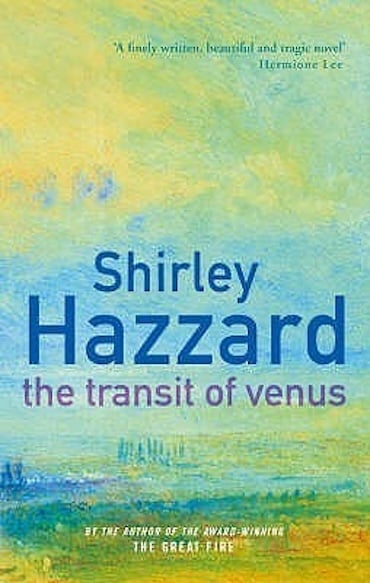
What’s true of work can be true of love. Hazzard often tracked couples on the verge of leaving one another. Or couples who compromised early on, only for one of them meeting another person they’re truly compatible with. Such missed moments are encapsulated in the metaphor contained in the title of The Transit of Venus, Hazzard’s best-known work.
Even today, it seems, astronomers struggle to predict when and where on our planet and Venus, in her celestial travel, will pass between us and the sun. In the novel by that name, an older figure reminds Caro, Venus’s main character, that had Captain Cook not gone in search of and mistaken the Transit’s timing, she would not be in England now. Yes, because Cook would not have landed on the unknown territory of Australia.
We mistake timing all the time: in love and work and war. One instance of good timing was when Hazzard’s sent her first story to The New Yorker’s slush pile, and it was accepted. She was also lucky in love with a sound marriage herself. She recalled that her first joy in writing about Greene on Capri was remembering her time with her late husband. And it is somehow comforting that Hazzard herself found the love and companionship that only some of her fictional characters do.
Hazzard’s Arrivals and Departures
In a body of work attuned to the arrivals and departures of travel, it’s also fitting that Hazzard’s first lines (always our own arrival into one of her stories) often contain that drama of a journey’s beginning. The Transit of Venus begins “By nightfall, the headlines would be reporting devastation.”
An unexpected storm has come, just as one of the key characters, Ted Tice, is arriving to serve as an assistant to a scientist at the latter’s country home. We first get to know Ted Tice by seeing him plod steadily through the storm towards his duty. He’s unaware that just as much as the storm he’s braving took others unaware, he is trudging through a harsh downpour towards the love of his life, Caro Bell. Weather, transits, pure chance, and secondary characters who sour relationships with their kin all figure in Hazzard’s stories.
. . . . . . . . . . .

. . . . . . . . . . .
Hazzard’s travels through family
“And they were starting,” initiates our journey into her third novel, The Great Fire, which the central character Aldred Leith launches from a train leaving a station. As the train sets off, his thoughts soon wander to the difference between himself and his father who wrote novels, love stories set all over the world — the reason why Leith had a rootless upbringing. But Leith doesn’t find his father especially loving, nor as fixed on departures as he is.
Other family members (and work colleagues) are more toxic, such as the parents of the sibling pair Leith befriends. The parents are only too willing when their teenage son gets a complex, undiagnosed illness, to let their daughter just a few years older, serve as primary caregiver.
The theme of parents unhappy with their children echoes across Hazzard’s fiction. As tough as work or love toxicity can be, surely family fissures are the hardest.
In her story, “In One’s Own House,” the mother admits which of her two sons she prefers. Her elder son had always seemed reproachful of her. We get a glimpse of where that reproach might come from when the mother thinks: “She was distressed but not surprised that he had managed to have a nervous breakdown.” The story unfolds under her roof, while the son she prefers, unknown to her, is hopelessly in love with his brother’s wife, who also living under her roof.
“Harold,” one of the early stories Hazzard published in The New Yorker (where she would continue to publish much of her work), describes an evening dinner among guests summering at a pensione outside of Siena, Italy. At last, romantic love is put aside. “It had all gone very well this year: no one had been ill, or quarreled or fallen in love. They were all on the best of terms, even with Miss Nicholson.”
The line is funny, as is much of Hazzard’s fiction. It is also striking because across her fiction, characters are ill, they quarrel, and most certainly fall in love. We watch these love stories from a distance, thanks to Hazzard’s precise and objective prose. As in life, people fall in love with the wrong person or with someone who is a mismatch, in terms of sentiment — as Jane Austen meant it: an equal level of experiencing the world or in terms of commitment. A man might genuinely be in love, but in real life, that might not dissuade him from marrying instead the heiress he’s engaged to.
In Hazzard’s writing, pleasure comes to those who are open to love and human connection, open to travel and experience, and, above all, to those who can put these adventures into words.
Contributed by Chris Prickett, a writer, editor, and retired professor of English and the humanities. Find her at ChristinePrickett.com.
. . . . . . . . . . .
A great overview of Shirley Hazzard and her travels, this really piques my interest in reading her novels, especially The Bay of Noon to compare it to my own experiences in Naples. 🙂
Thank you, Lidia. Kudos to Chris Prickett for this fascinating overview of an aspect of Shirley Hazzard’s work.