Émilie du Châtelet (1706–1749), mathematician, physicist & translator
By Marie Lebert | On June 27, 2026 | Updated September 4, 2026 | Comments (0)
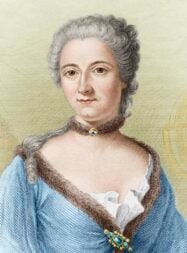
Émilie du Châtelet (1706–1749) was a French mathematician, physicist, and translator. Her major work as a writer was Foundations of Physics, first published in 1740.
Her major work as a translator was the translation of fellow scientist Isaac Newton’s seminal book Mathematical Principles of Natural Philosophy from its original Latin into French. Published in 1759, her translation is still the standard French translation to this day.
Émilie du Châtelet received a good education in literature, mathematics and science. After marrying the Marquis du Châtelet at the age of nineteen and bearing three children, she resumed her mathematical studies in 1733 at the age of twenty-six.
She became the intellectual collaborator and romantic partner of the French philosopher Voltaire, one of the key figures of the Enlightenment. Later on, while still being friends with her husband and with Voltaire, she began an affair with the French poet Jean Francois de Saint-Lambert but didn’t survive a new pregnancy one year later.
Émilie was the first woman to have an essay published by the French Royal Academy of Sciences in 1739. Her essay dealt with the nature and propagation of fire (“Dissertation sur la nature et la propagation du feu”).
. . . . . . . . . .
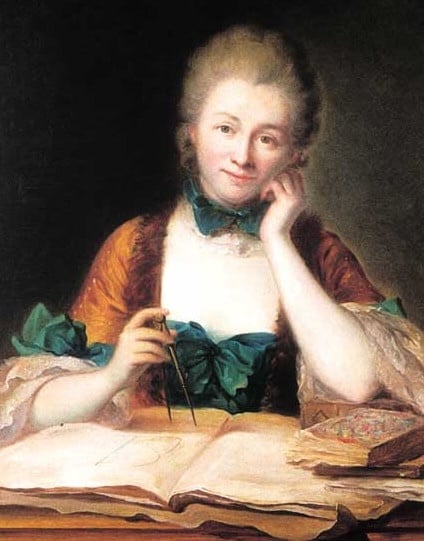
Émilie du Châtelet
. . . . . . . . .
Foundations of Physics
Émilie du Châtelet’s main work as a writer was Foundations of Physics (original title: Institutions de Physique), published in Paris by Prault fils in 1740. A second edition was published in 1742, with a revised text under a slightly different title, Institutions Physiques.
Foundations of Physics synthesised and discussed the main ideas expressed by the prominent mathematicians and physicians of her time. The book covered many subjects, including the principles of knowledge, the existence of God, space, time, matter and the forces of nature, as well as Isaac Newton’s theory of motion and universal gravitation, which was attracting a lot of interest among her peers.
Foundations of Physics was translated into German and Italian in 1743. Her ideas were expressed in some chapters of the famed French Encyclopédie, a monumental encyclopedia in twenty-eight volumes (seventeen volumes of texts and eleven volumes of plates) published in France between 1751 and 1772 to incorporate all of the world’s knowledge, with many contributors.
Mathematical Principles of Natural Philosophy
Émilie’s main work as a translator was the translation into French of fellow scientist Isaac Newton’s Mathematical Principles of Natural Philosophy (original title: Philosophiae Naturalis Principia Mathematica), often referred to as Principia.
Written in Latin and first published in 1687, with two further editions in 1713 and 1726, the three-volume book details Newton’s laws of motion and his law of universal gravitation, and the mathematical methods Newton used in formulating his physical laws. Principia is now considered one of the major works in the history of science.
All the translations were based on the third edition in 1726. An English translation authored by the English mathematician Andrew Motte was published in 1729, with several subsequent editions.
The French translation authored by Émilie du Châtelet included a summary section (a common summary for the three volumes), an extensive commentary section (two thirds of the second volume) and an analytical section in which she applied the new mathematics of calculus to Newton’s most controversial theories.
The first French edition (considered “temporary”) was published in Paris by Desaint & Saillant in 1756, six years after Émilie’s death, under the title Principes mathématiques de la philosophie naturelle [traduits] par feue Madame La Marquise du Chastellet. The second French edition (considered “final”) was published in two volumes by Desaint & Saillant in 1759, and is still the standard French edition to this day.
Her translation was a major step for the dissemination of Newtonian physics in France and in Europe and for the completion of the two-century Scientific Revolution which led to an empirical and evidence-based approach to science.
The Fable of the Bees (1715)
Émilie also translated The Fable of the Bees (1715) by the Anglo-Dutch social philosopher Bernard Mandeville under the title La Fable des Abeilles (1740).
In the preface to her translation, considered less a translation than a free adaptation into French, she strongly argued for the education of women, particularly a secondary education for young women as was available for young men. She explained that, by denying women a good education, society prevented women from becoming eminent contributors in the arts and sciences.
Being a learned woman respected by her peers didn’t prevent misogynistic comments. As stated by the German philosopher Immanuel Kant in his Observations on the Feeling of the Beautiful and Sublime (original title: Beobachtungen über das Gefühl des Schönen und Erhabenen), published in German in 1764:
“A woman who has a head full of Greek, like Mme Dacier [a French scholar and translator], or who conducts disputations about mechanics, like the Marquise du Châtelet, might as well also wear a beard; for that might perhaps better express the mien of depth [the overall appearance] for which they strive.”
But Kant did read their works, which probably influenced his own writings.
Further reading
- History of Scientific Women
- Who was Émilie du Châtelet and Why Does She Matter?
- The Scientific Trailblazer Who Turned Heads in Versailles
Contributed by Marie Lebert. Reprinted by permission. Marie is a bilingual French-English translator. She has worked as a translator and/or librarian for international organizations and has written ebooks, articles and essays about translation and translators, ebooks, libraries and librarians, and medieval art. She holds a doctorate of linguistics (digital publishing) from the Sorbonne University, Paris, and a master of social science (society and culture) from the University of Caen, Normandy. See more entries by Marie Lebert, most profiling women translators, on Literary Ladies Guide. Find more about women translators of the past at Marie Lebert.
Leave a Reply